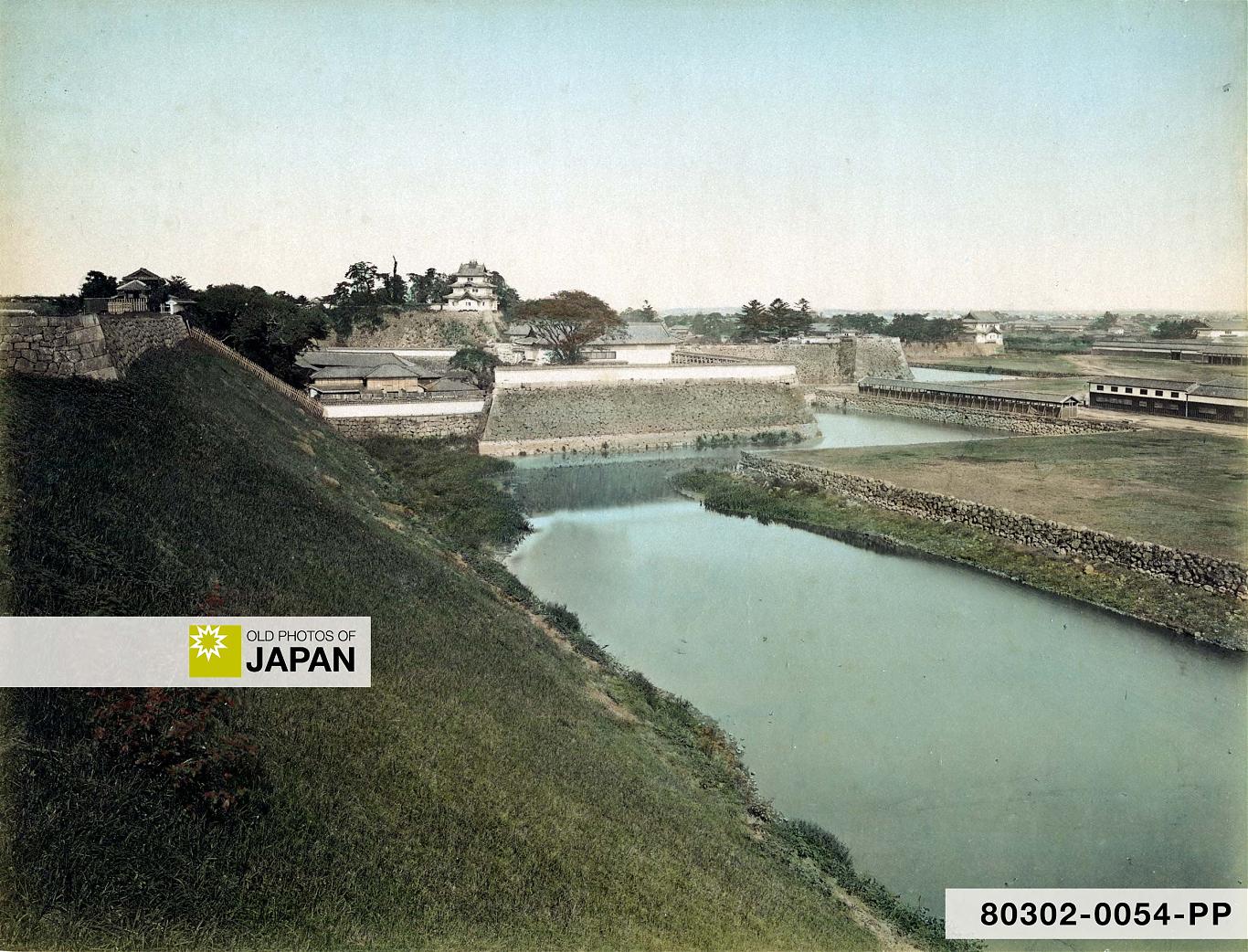
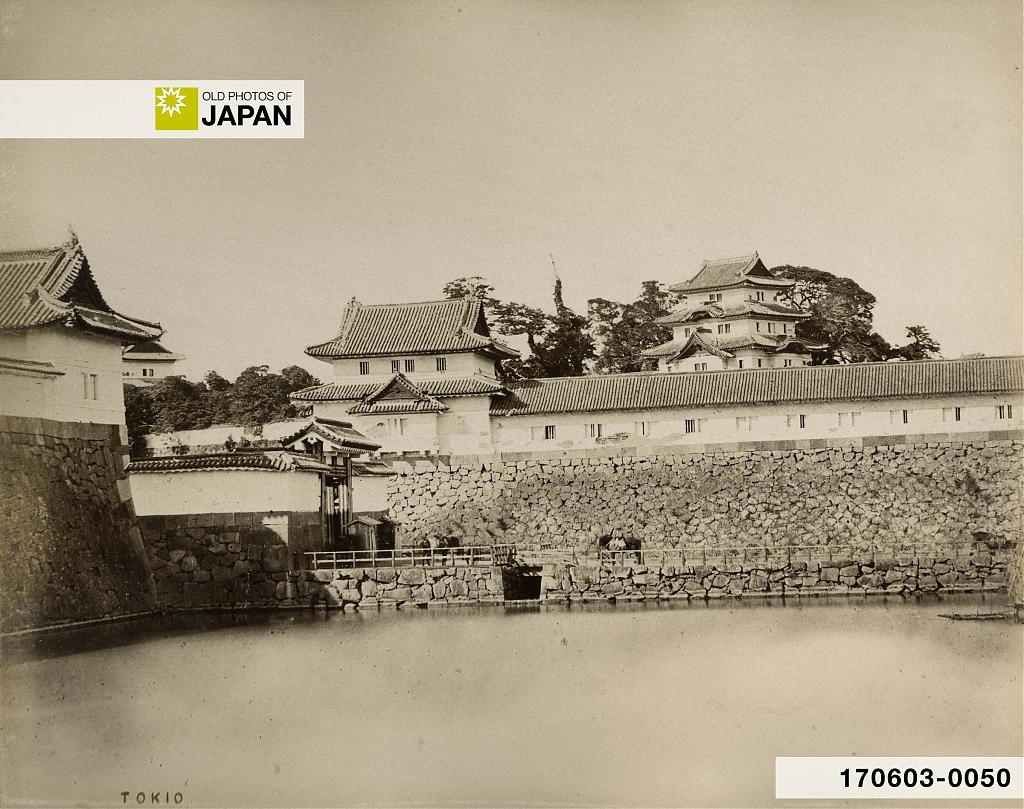
Edo Castle between 1872 and 1874. In the center is the Sakashita Gate; in the background, the Fujimi Yagura turret. Both still exist today. The massive castle, built in a marsh, was the heart of a new social order from which the unique culture emerged of Tokyo’s Ueno district.
How Ueno Tells the Story of Japan
This is Part 2 of an essay about the history of Tokyo’s Ueno district.
This rescue project is funded by readers like you
Old Photos of Japan provides thoroughly researched essays and rare images of daily life in old Japan free of charge and advertising. Most images have been acquired, scanned, and conserved to protect them for future generations.
I rely on readers like you to keep this online museum going.
Ueno’s Hidden Roots
The previous article, Ueno Before the Quake, briefly introduced the area in front of Tokyo’s Ueno Park just before the 1923 Great Kantō Earthquake turned it to ashes. It was a vibrant maze of geisha houses, rendezvous teahouses, and top-class restaurants, many with a breathtaking view of the lotus-filled Shinobazu Pond.
Before diving deeper into Ueno, we first jump back in time to understand how its unique culture emerged. This article explores how Tokyo, then called Edo, was established by the ambitious warlord Tokugawa Ieyasu (1543–1616).
Over a decade before becoming shogun, he built a stronghold in what was a marshy, low-lying wetland, far removed from the centers of power in Kyoto and Osaka. It was on the very edge of what the elite considered the civilized world.
In this challenging landscape, Ieyasu and his successors built a radically new social order that transformed Japan. Squeezed between the powerful forces unleashed by this new order and the natural splendor of Shinobazu Pond, Ueno’s unique culture was born.
This article explores Edo before Ieyasu’s arrival and what he built there. It all started with a castle in a marsh…
Marshy Wetlands
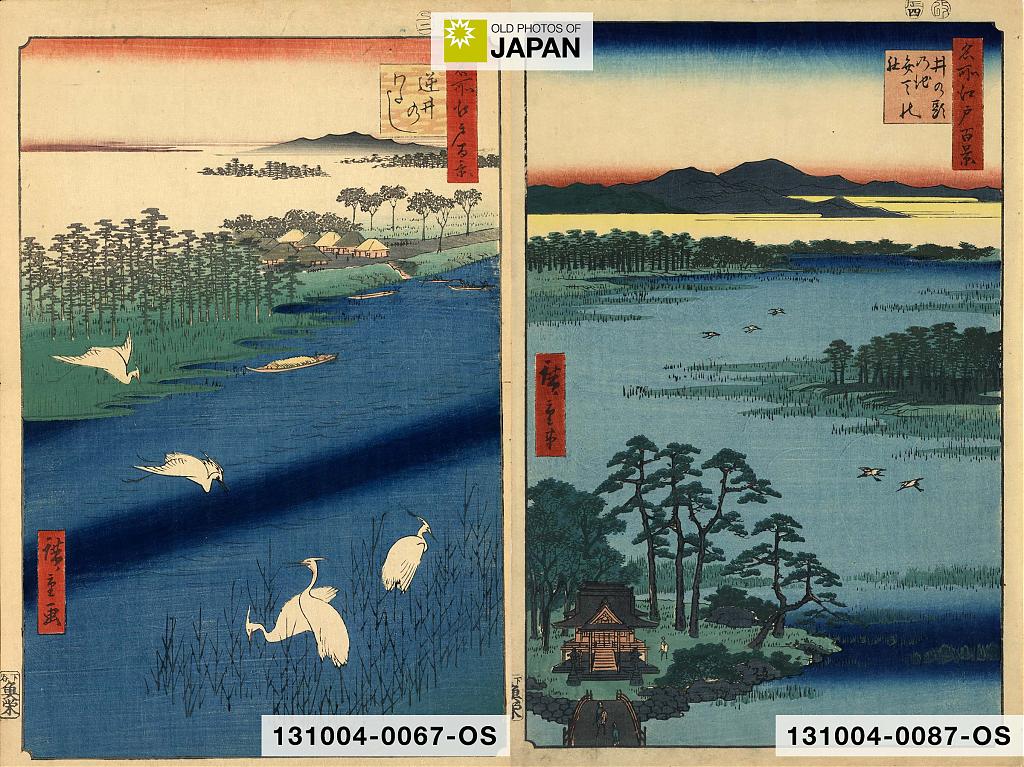
Ueno’s story as a place of entertainment, power, and commerce starts in August 1590 (Tenshō 18) when Tokugawa Ieyasu moved his clan from Suruga Province (present-day Shizuoka Prefecture) to the marshy shore of Tokyo Bay. At the time, the bay extended as far inland as Hibiya Park near the Imperial Palace.
The area was a low-lying expanse of wetlands, winding rivers, and tidal inlets, with scattered villages connected by roads and waterways.1 Inhabitants made a living from fishing, farming, hunting, and regional trade. Small ports served as gateways between coastal shipping routes and the Kantō hinterland.
A large number of shrines and temples served the wetland communities. One was the now renowned Sensōji temple, believed to have been established as early as 628. It is marked on the map below (7), showing Edo around 1540.2
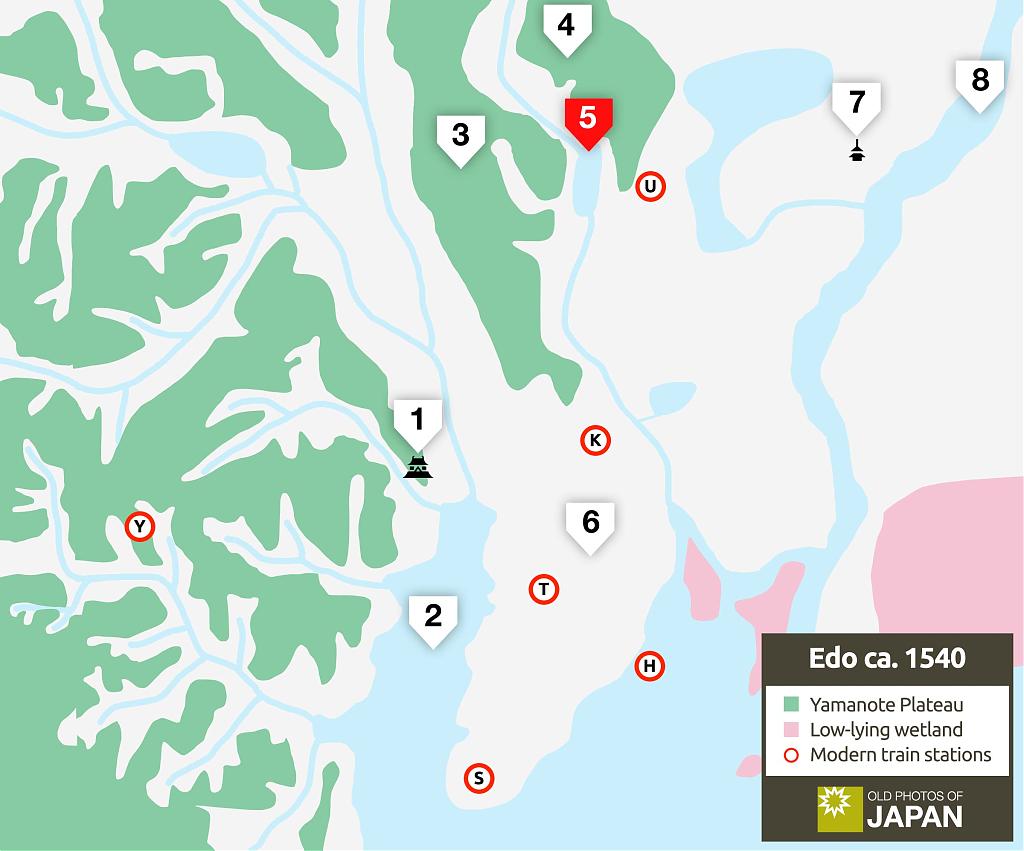
Sloping upwards from this flat coastal wetland was the Yamate Daichi (山手台地, Yamate Plateau), a massive, finger-like plateau system that offered a sweeping view over the low-lying wetlands.
The southeastern terminal tip of these hills was the densely forested Ueno-no-yama (上野の山, “the mountain of Ueno”), now the location of Ueno Park. Next to it lay the large reed-lined Shinobazu Pond (5 in the above map). The river that fed it streamed on into the bay. Nearby were a few Shinto shrines, one of them on Ueno-no-yama itself, indicating the existence of small communities.3
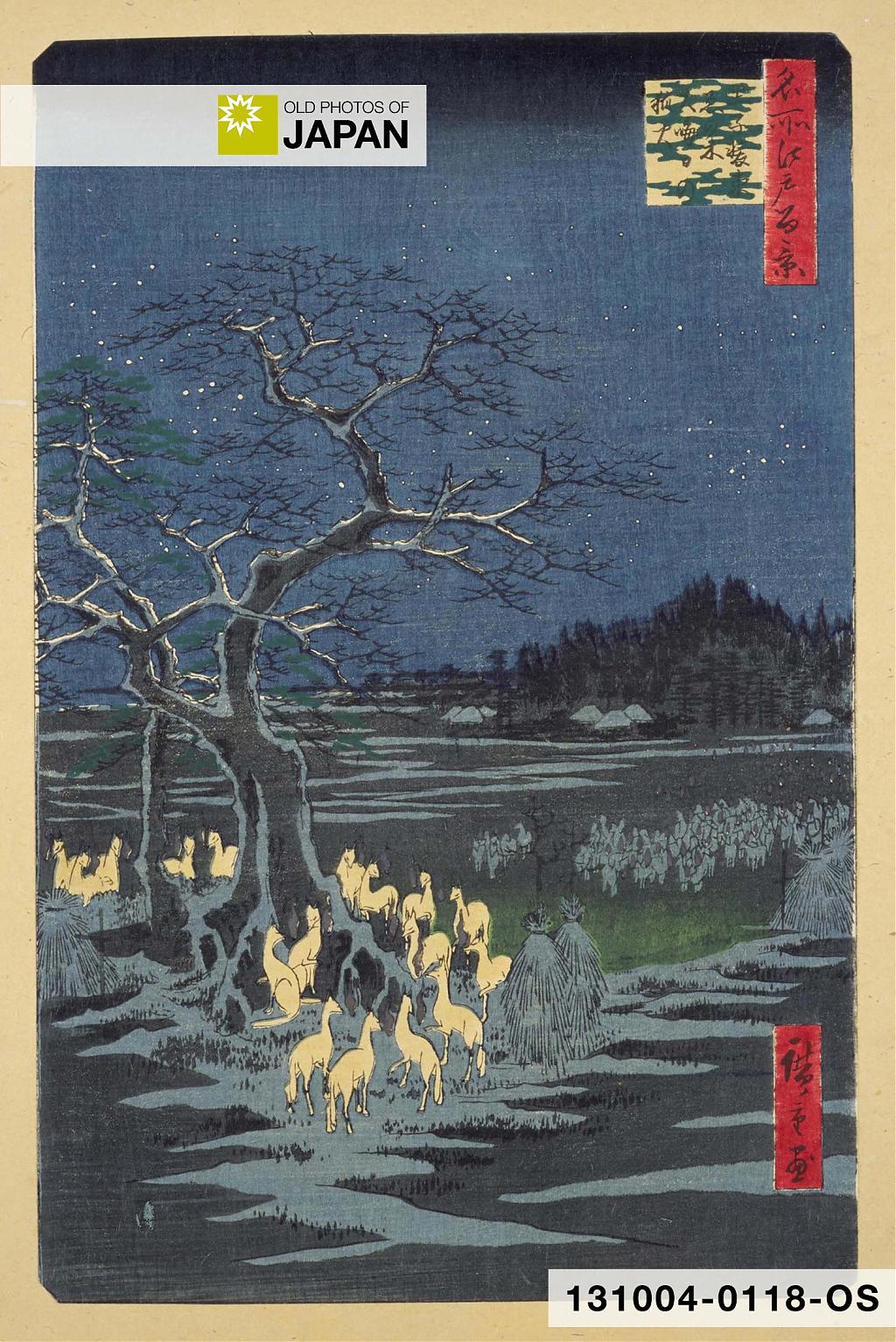
The marshes and hills were an ideal habitat for animals, especially migratory waterbirds and the animals that hunted them, such as foxes. Because people encountered foxes all the time, they became fixtures of Edo folktales. Their eerie, high-pitched screams likely contributed to their reputation as supernatural, shapeshifting creatures.
Edo Castle
On a hill near the tip of Hibiya Inlet stood Edo Castle. It was constructed in 1457 (Kōshō 3) by Ōta Dōkan (太田道灌, 1432–1457), a retainer of the Uesugi clan. From 1524 (Daiei 4), it was under the control of the powerful Hōjō clan.
Iwabuchi Yawa (岩淵夜話), a historical manuscript about Tokugawa Ieyasu written by military scholar Daidōji Yūzan (大道寺友山, 1639–1730), describes how the low-lying tideland immediately outside the castle walls was prone to flooding:4
It was, I believe, about the year after Lord Ieyasu entered Edo. Following prolonged rains, a great southern gale arose, bringing with it a high tide that inundated the fishermen’s district. The fishermen placed their wives and children aboard boats, collected their household effects, and moored the boats amid the floodwaters in the fields around what is now the interior of Babasaki Gate, where they prepared food and remained for a time. It is said that this scene was observed by one who was going up to the castle on guard duty.
Relatively little is known about the castle before 1590. An Edo period source (1603-1868) mentions that instead of stone walls, it had earthen embankments overgrown with bamboo and trees. The straw roofs of its buildings leaked, and the floors were made of compacted soil.5 Military scholar Daidōji describes the castle and its surroundings at this time as follows:6
The land was so marshy with tidal reeds that there was scarcely any place even to lay out a modest district of townsmen’s and samurai residences. To the southwest stretched endlessly the grassy plains of Musashino, without any clear defensible boundary. As for Edo Castle itself, it had never been the residence of a ruler of an entire province. Ōta Dōkan of the Uesugi house had first marked out and built it, and afterward the Tōyama family of the Hōjō had resided there. Thus the castle was small, the moats narrow, and the gates and walls unimpressive. It was natural that people could not imagine it becoming the residence of the lord of the eight provinces of Kantō.
Daidōji wrote this account around 1700, after the completion of the new Edo Castle, then by far the largest castle complex in Japan. His portrayal may be colored by hindsight, emphasizing the contrast between the modest Hōjō-era stronghold and the vast complex that Edo Castle had become.
Surviving Hōjō records from 1559 (Eiroku 2) suggest that the pre-Tokugawa castle was more significant and complex than his account implies. It was administered by three castellans (城代, jōdai): one responsible for the main enclosure, one for the second, and one for what is believed to have been the outer defensive works.7
The records also state that the corps attached to the castle consisted of 103 retainers with estates throughout the surrounding region.8 How many soldiers these retainers could field is unknown, but later Hōjō military regulations suggest a force numbering perhaps in the low thousands when fully mobilized.
Archaeological excavations have also uncovered evidence of buildings near the fortress, possibly the remains of a small town.9 Taken together, these records and archaeological findings suggest that Edo Castle was already an important strategic stronghold decades before Ieyasu’s arrival.
Building Power
Even though there was pre-existing infrastructure, the marshy landscape and small scale of Edo Castle still posed formidable challenges to Ieyasu.
The castle had to be enlarged to accommodate his much larger force, reliable freshwater supplies secured, port facilities improved, massive land-reclamation and flood-control projects were needed to enable large-scale construction, and thousands of Ieyasu’s retainers and their families “had to pick up their entire households and equipment and find new houses in unfamiliar territory.”10
These challenges were dwarfed by the political challenges he was about to face. When Ieyasu entered Edo, Japan had endured over a century of bloody civil wars, a period now known as the Sengoku period (戦国時代), the Warring States period.
In the middle of this period, in the 1560s, Oda Nobunaga (織田信長, 1534–1582) had initiated Japan’s unification process, conquering much of central Japan. After his assassination in 1582 (Tenshō 10), his top general, Toyotomi Hideyoshi (豊臣秀吉, 1537–1598) seized power and completed Japan’s military unification in 1590 when he defeated the Hōjō clan at Odawara. He ordered Ieyasu, who had played a pivotal role in this victory, to give up his fief and rule in the Kantō region.11
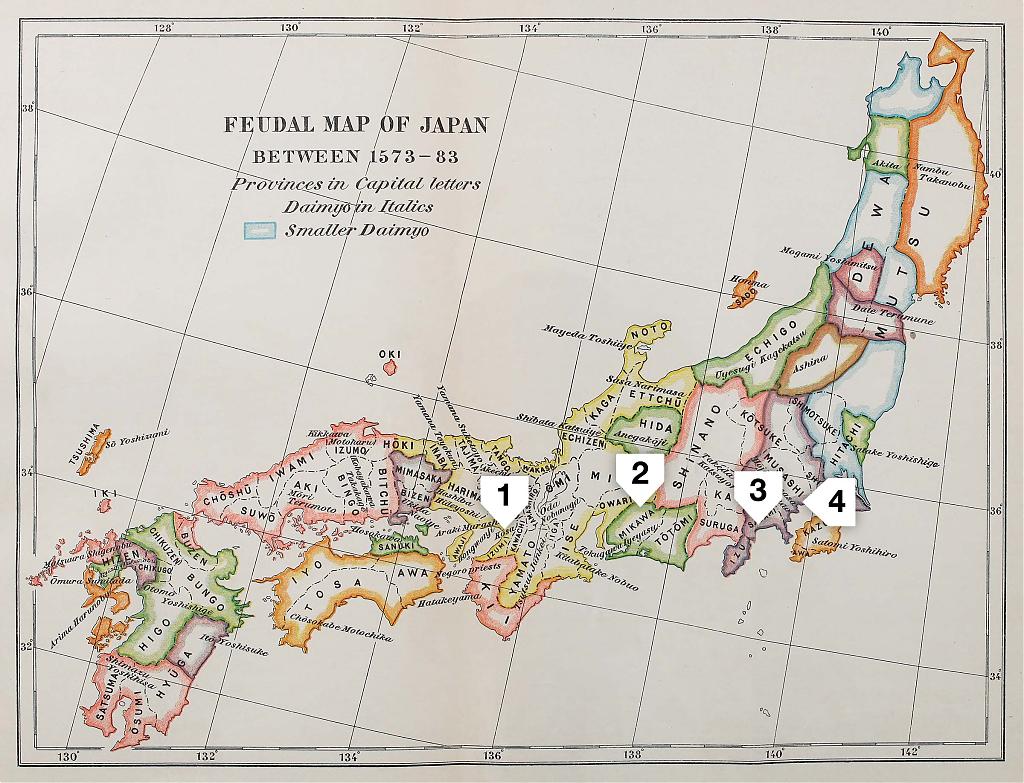
When Hideyoshi died in 1598 (Keichō 3), he left behind only a five-year-old son, creating a massive power vacuum. Ieyasu had sworn to protect the child as part of a governing council of regents. However, he immediately began outmaneuvering his rivals, isolating Toyotomi loyalists and building his own alliances. Within two years, Japan’s warlords were split into two warring factions.
Ieyasu obliterated much of his opposition when he emerged as the victor at the decisive Battle of Sekigahara in 1600 (Keichō 5). When Emperor Go-Yōzei (後陽成天皇, 1571–1617) formally appointed him as shogun in 1603, it may have appeared as if nothing else needed to be done. History books even mark 1603 as the start of the Edo Period.
However, even though Ieyasu was now the shogun and could order daimyo virtually at will, a last threat to his power still remained: Hideyoshi’s son. He finally removed this threat when he defeated the remaining Toyotomi clan during the Osaka Summer Campaign in 1615 (Genna 1). The House of Tokugawa now held absolute military and political supremacy in Japan.
The New Castle
While Ieyasu fought his battles to attain supreme power, he also enlarged Edo Castle. Construction had begun soon after his arrival in Edo, and increased significantly each time his power increased. After he became shogun, he ordered daimyo throughout the country to send personnel and material, solidifying his authority and transforming the construction of Edo Castle into a national project.
However, until 1615, Edo Castle had been primarily built up as a heavily fortified military stronghold. Now that the Tokugawa Shogunate had established absolute control over Japan, it swiftly shifted its focus to building a national bureaucracy and turning Edo into the administrative, economic, and political heart of Japan.
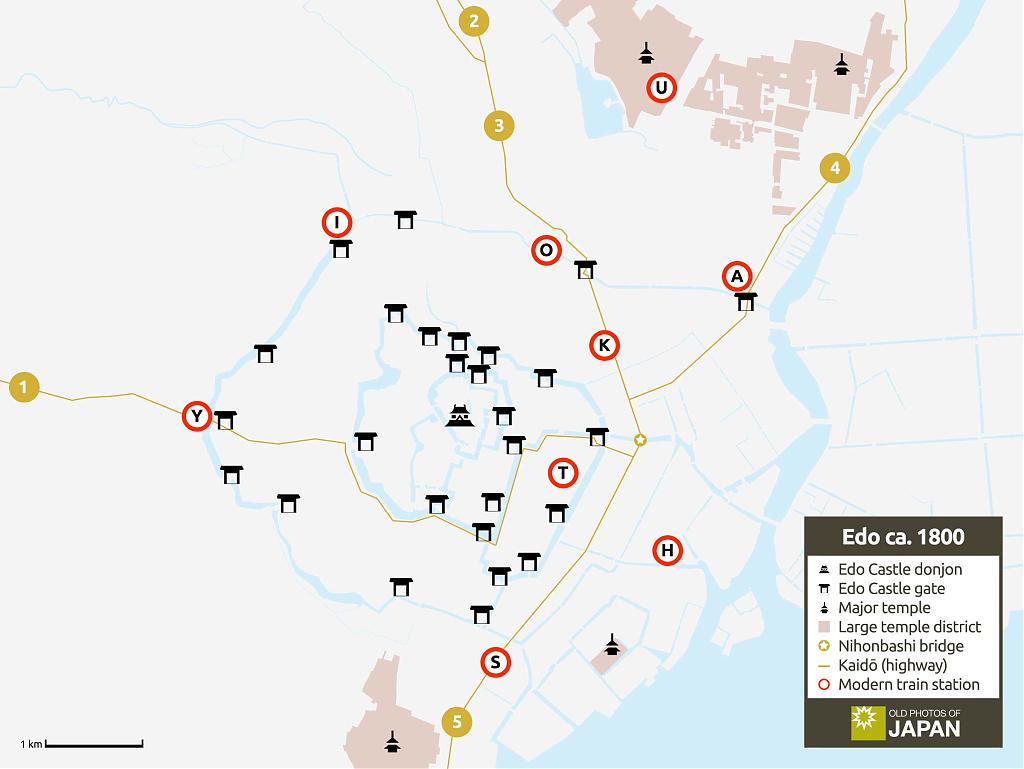
This transformed Edo Castle into the key symbol of the shogunate’s political and military supremacy. Enormous effort and funds were expended to make it as impressive as possible. When Edo Castle was finally completed in 1636 (Kan’ei 13), it was Japan’s largest castle.12 It boasted 36 gates, five kilometers separating the two most distant outer ones: Asakusa to the east and Yotsuya to the west.
The map below shows Edo Castle and 27 of its 36 gates around 1800 (Kansei 12), identical to the configuration after the castle’s completion. To convey the vast scale of the complex, I have added the locations of present-day train stations.13
Notice how Hibiya Inlet and much of the surrounding coastline were reclaimed. The site of present-day Hatchōbori Station is no longer underwater. Rivers were rerouted, shorelines reshaped, and the landscape completely transformed. Most of this was accomplished during the shogunate’s early decades.
The massive castle became the heart of a new socio-political order that reached so deeply into society that it was etched into the very layout of Edo. In the next article, we discover how a 54-year-old mother taken hostage by Ieyasu just before the pivotal Battle of Sekigahara started off voluntary acts of loyalty by leading daimyō. In return, they received land in Edo to build vast residences.
Continue to Part 3: Edo: Japan’s New Center of Power.
Notes
The Edo map before Tokugawa is based on 鈴木理生 (2000)『江戸はこうして造られた』筑摩書房, 21, other maps, and comparisons with modern maps to determine the estimated locations of the stations and Sensōji temple. The scale, outlines, and locations of the topographic features on the Old Photos of Japan map are approximations.
1 齋藤慎一 (2020)『「高橋」と「大橋」 ~中世から近世初頭における江戸城下の景観~』東京都江戸東京博物館紀要 第10号 2020年3月.
2 Many other temples and shrines from this period also still exist today, such as the Torigoe Shrine (established in 651), Kanda Myojin Shrine (730), Shiba Daijingū temple (1005), Zojoji temple (1393), and Hie Shrine (1478).
3 The shrine on Ueno-no-yama was the Gojō Tenjin Shrine (五條天神社). According to legend, it was founded around 110 A.D. by the legendary prince Yamato Takeru. Documents confirm the shrine was on Ueno-no-yama by the mid-Muromachi period (1336–1573). The shrine was relocated multiple times. It was moved into Ueno Park after the 1923 Great Kanto Earthquake, essentially returning to its original home base. It still stands there today.
4 齋藤慎一 (2021) 『江戸の改変―文禄・慶長前半期の様相―』東京都江戸東京博物館紀要 11号 (2021年3月), 6.
「⑮ 御入国の翌年あたりの事かと覚申候、長雨の以後、大南風の吹候義有之、其節高汐上り、件の猟師町へ水つき候ゆへ、猟師共船に妻子を乗せ、家財を取つみ、唯今馬場先御門内になり候あたりの畑中に有之候、大水共に船を繋き、食事などを調へ罷在を、御城へ御番に上り候砌、見かけ候よし、」
5 齋藤慎一 (2021) 『江戸の改変―文禄・慶長前半期の様相―』東京都江戸東京博物館紀要 11号 (2021年3月), 5–6.
「⑩ 遠山時代の城と申には、石垣なと築候所とては一ケ所も無之、皆芝土居にて土手には竹木茂りあひ有之候由、⑪ 其時代には只今の内桜田・大手御門の辺より三の御丸平川口迄の間には、かきあげ土居の様なる惣構の形有之、土手には竹木生茂り、四五ケ所斗に海端に出入仕る軽き木戸門も有之、其内には遠山が家中の侍共の居屋敷の由にて、余程大きなる家も有之、尤少き家の義は余多有之、寺なとも二三ケ所有之、籠城の節、自焼をも不仕、其儘にて残り有之候に付、御入国節、殊の外御用に相立と也、遠山時代という記載ではあるものの、徳川家康入城段階に見られたものが中心となっている。基本的には家康段階で継承されなかったという意識なのだろう。」
6 大道寺友山『岩淵夜話 -徳川家康説話集ー』巻三三話「関東入国江戸の建設」内閣文庫蔵写本(159-22)に基づく翻刻. Retrieved on 2026-05-24.
「子細ハ其時迠ハ東ノ方平地ノ分ハ爰モカシコモ汐入ノ芦原ニテ町屋、侍屋敷ヲ十町ト割付へキ様モナク、扨又西南ノ方ハビヤウビヤウト萱原武蔵野ヘツヅキ、ドコヲシマリト云ヘキ様モナシ。御城ト申セバ昔ヨリ一国ト持、大将ノ住タルニモ非ズ、上杉家ノ家老大田道灌斎初テ縄ヲ張取立、其後北条家ノ遠山居住セシ迠ナレバ、城モチイサク堀ノ幅モ狭ク門塀ノ躰迠中々浅間ナル様子ナレハ、関八州ノ太守ノ御座城ト可被成様躰ニハ人々不存寄モ理リナリ。」
Note: Daidōji’s reference to “the Tōyama family” reflects an Edo-period understanding of Edo Castle’s history. Sixteenth-century Hōjō records instead indicate that Edo Castle was administered through a complex command structure headed by multiple castellans (jōdai), suggesting a more institutional arrangement than Daidōji’s brief account implies.
7 港区総務部総務課 (2020)『図説 港区の歴史』港区, 75 (online text).
8 東京都品川区 (1973)『品川区史 通史編 上巻』東京都品川区, 370 (online text).
9 齋藤慎一 (2020)『「高橋」と「大橋」 ~中世から近世初頭における江戸城下の景観~』東京都江戸東京博物館紀要 第10号 2020年3月.
10 Hall, John Whitney (2006). The Bakuhan System in The Cambridge History of Japan: Volume Four, Early Modern Japan. New York: Cambridge University Press, 137, 141.
11 The relationship between Hideyoshi and the ambitious Ieyasu was an uneasy and difficult one, partly overlord and autonomous warlord, partly uneasy allies. Historians have therefore long debated whether Ieyasu’s transfer to the Kantō after the Siege of Odawara was a reward or a strategic move to sideline a rival. On the one hand, Ieyasu’s assessed domain wealth increased by over sixty percent to roughly 2.4 million koku, cementing his position as the wealthiest and most powerful warlord under the regime. (Berry, Mary Elizabeth (1982). Hideyoshi. Cambridge, Mass.: Harvard University Press, 95–96.)
On the other hand, Hideyoshi successfully removed Ieyasu from the geopolitical power centers of Osaka and Kyoto, while keeping him occupied with keeping former Hōjō retainers and a restive eastern frontier in check.
Recently, historians have moved away from viewing this as a personal slight or a reward, leaning instead toward the idea that the transfer was a pragmatic geopolitical calculation. Ieyasu was simply the only warlord with the immense military and administrative capacity required to pacify Japan’s eastern territories.
Note: “A koku of rice (180 liters or about 150 kilos) was theoretically the amount necessary to feed a man for a year and served as a rough indicator of wealth. When, however, a warrior was said to be worth, say, 1000 koku, this referred not to his net income but to the putative yield of the terrain he controlled. The actual revenues were far less, sometimes only a third of this amount.” Groemer, Gerald (2019). Portraits of Edo and Early Modern Japan: The Shogun’s Capital in Zuihitsu Writings, 1657–1855. Singapore: Palgrave Macmillan, XV.
12 Edo Castle was roughly twice the size of the next largest, Osaka Castle.
13 The map also shows the major highways (kaidō) that originated from Nihonbashi Bridge, previously discussed in Birth of a Nation.
Published
Updated
Reader Supported
Old Photos of Japan aims to be your personal museum for Japan's visual heritage and to bring the experiences of everyday life in old Japan to you.
To enhance our understanding of Japanese culture and society I track down, acquire, archive, and research images of everyday life, and give them context.
I share what I have found for free on this site, without ads or selling your data.
Your support helps me to continue doing so, and ensures that this exceptional visual heritage will not be lost and forgotten.
Thank you,
Kjeld Duits
Reference for Citations
Duits, Kjeld (). Tokyo 1870s: A Castle in a Marsh, OLD PHOTOS of JAPAN. Retrieved on October 24, 2026 (GMT) from https://www.oldphotosjapan.com/photos/996/tokyo-edo-castle-origins-tokugawa-ieyasu-a-castle-in-a-marsh


Noel
Have you seen the the collection of documentary photographs of former Edo Castle created by Ninagawa Noritane in 1871 with the cooperation of photographer Yokoyama Shozaburo and artist Takahashi Yuichi?
#000909 ·
Jack Blue
雪葵 雅に映る 忘れ潮
海原唄う 石垣の草
yuki aoi
miyabi ni utsuru
wasure jio
unabara utau
ishigaki no kusa
a snowy mallow
nobly floats around the tide
of oblivion’s sea
beside the melodious grass
on the watery blue stones
een sneeuwmalve
drijft edel rond de getij
van vergetelheid
naast het zoetklinkende gras
op de zeeblauwe stenen
#000916 ·