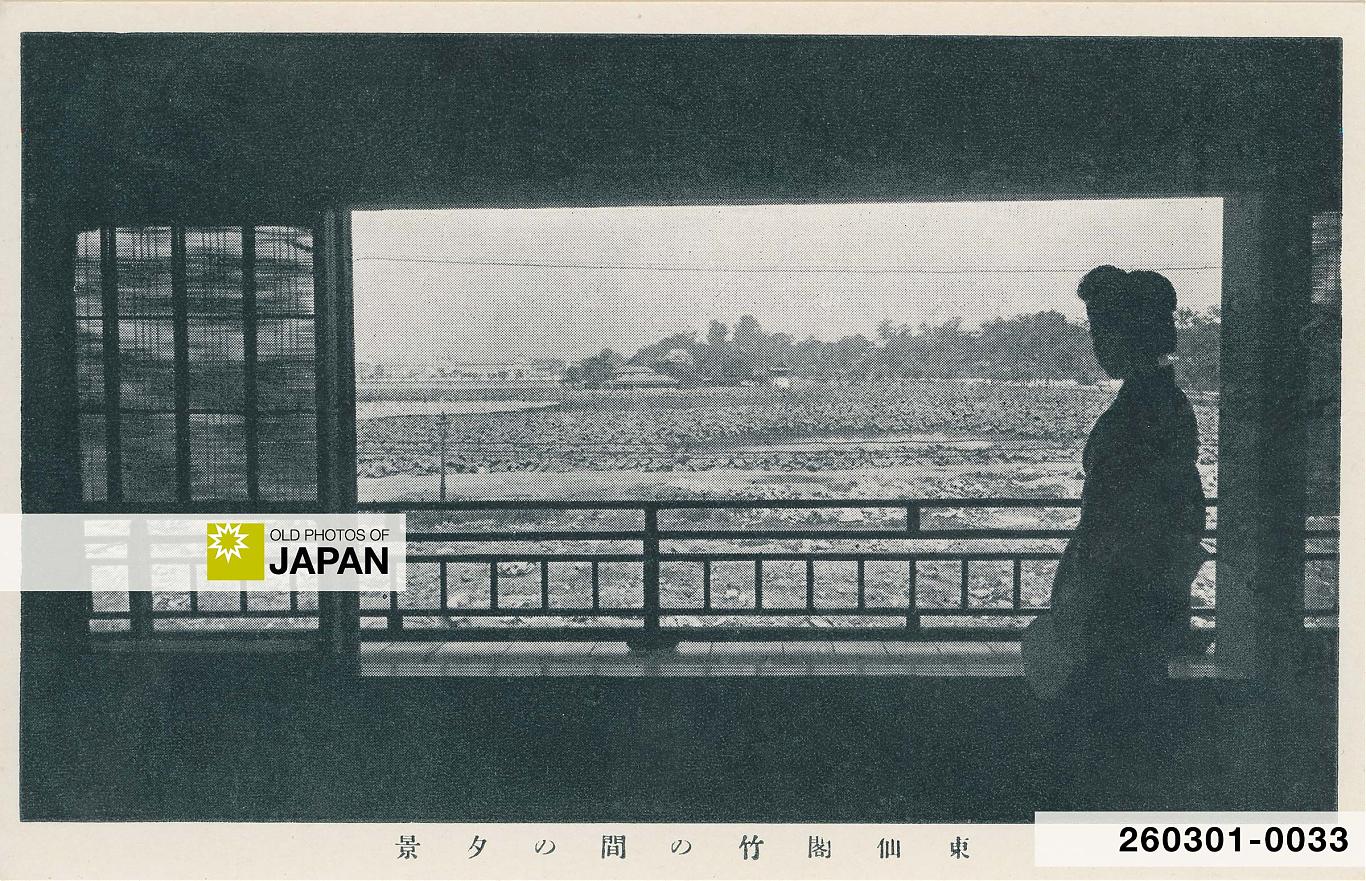
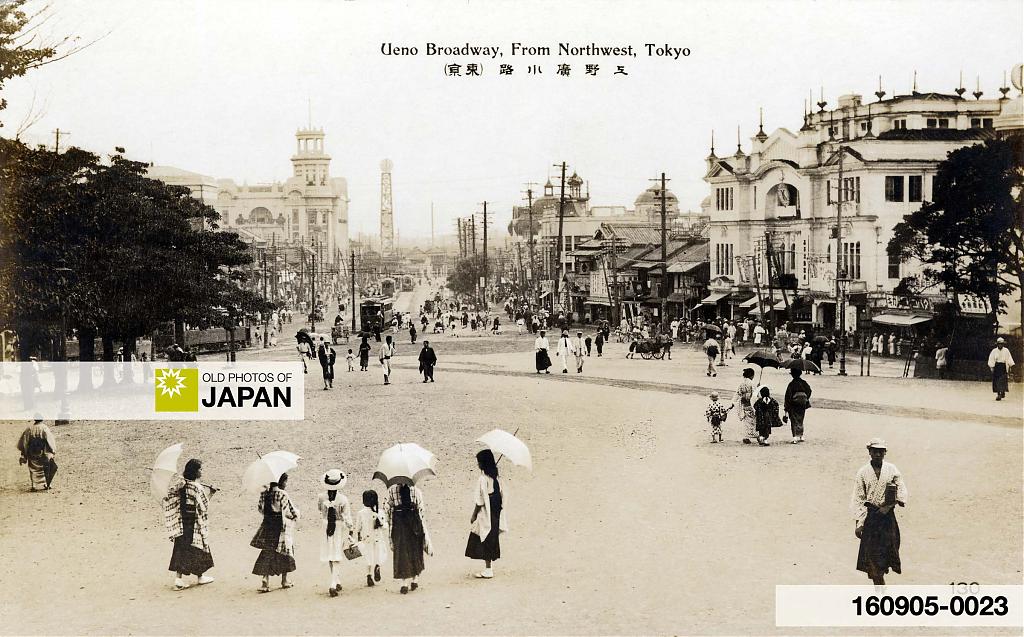
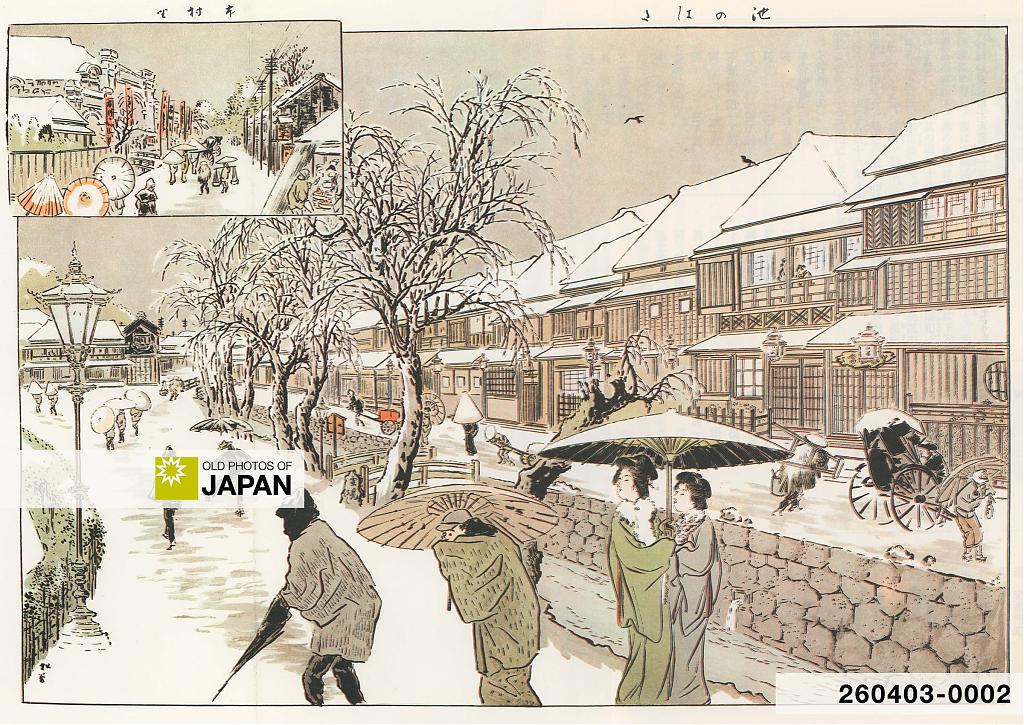
Before it was razed by the terrifying fires of the 1923 quake, the area in front of Tokyo’s Ueno Park was a vibrant maze of geisha houses, rendezvous teahouses, and top-class restaurants, many with a breathtaking view of the lotus-filled Shinobazu Pond. It was a place where geisha, art, and power met and mingled.
How Ueno Tells the Story of Japan
This is Part 1 of an essay about the history of Tokyo’s Ueno district.
This rescue project is funded by readers like you
Old Photos of Japan provides thoroughly researched essays and rare images of daily life in old Japan free of charge and advertising. Most images have been acquired, scanned, and conserved to protect them for future generations.
I rely on readers like you to keep this online museum going.
Ueno was one of early 20th century Tokyo’s most vibrant social hubs. Students and professors from nearby Tokyo Imperial University and the Tokyo School of Fine Arts made it their hangout. Authors, poets, and artists discussed their latest works and unwound. Businessmen and officials made deals at lavish geisha parties.
A steady stream of people passed through on their way to the museums and zoo in Ueno Park, or to admire the cherry blossom and lotus flowers of Shinobazu Pond. Young people came for the modern Western-style restaurants and cafes with pretty waitresses and billiard halls.
Squeezed in between the restaurants, teahouses, and geisha houses, were shops selling everything from trendy Western imports, the latest records, and medical instruments to traditional kiseru pipes, kimono, and writing brushes. Artisans crafted musical instruments, combs, and jewelry at workshops facing Shinobazu.
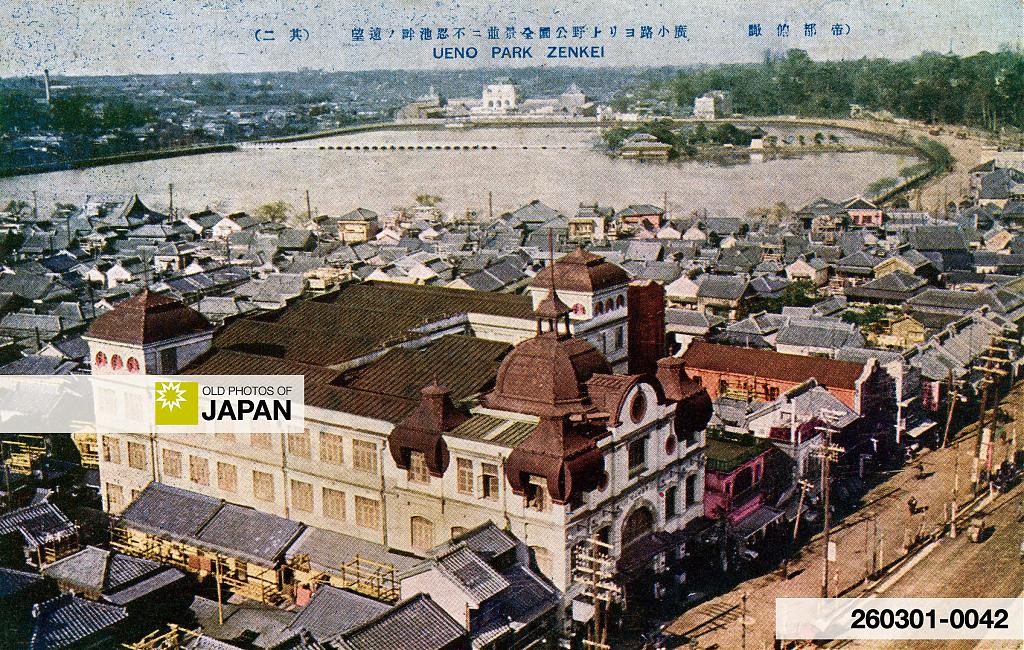
Visiting the neighborhood was an adventure. One was bombarded with cultural, natural, and sensory experiences. Geisha song and music leaked out onto the streets, as did laughter from comedy shows. Vendors loudly priced their wares, or drew customers in by performing acrobatic tricks.
Stepping through a restaurant gate brought one into elegant gardens with ponds and bridges. One restaurant boasted live cranes in its garden, and a miniature mountain. Many restaurants had baths. One bath was so special it was reported in the newspaper.
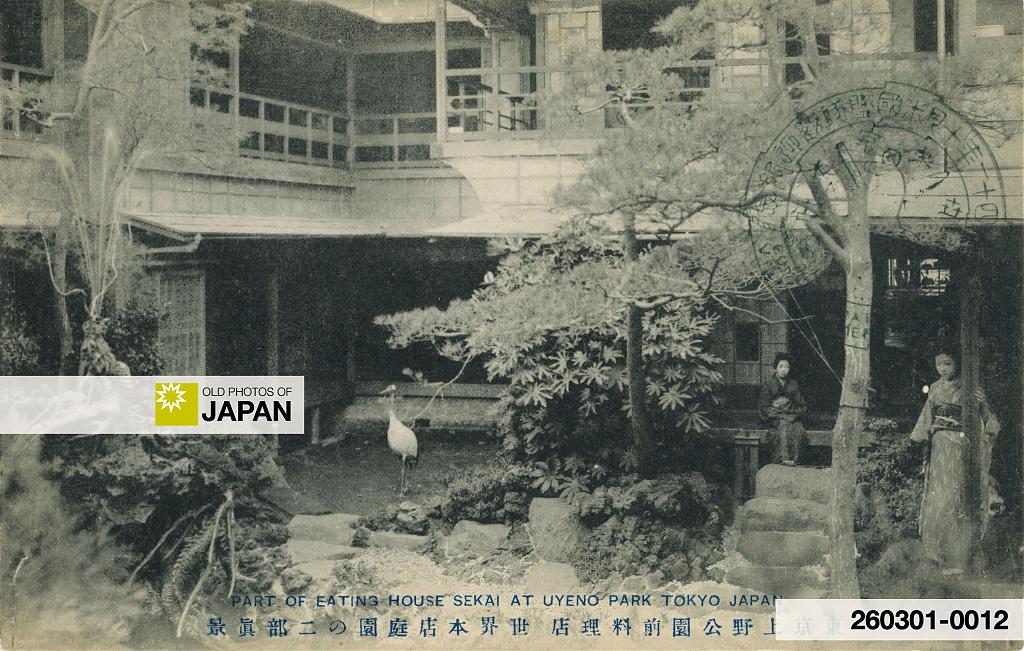
The diversity of Ueno, then known as Shitaya, distinguished its geisha from those in other quarters.1
The customers to the Shitaya circles comprehend all ranks of people, and it is a speciality of the quarter that the girls here are often hired to the meetings of artists and scholars; hence the Shitaya girls have many more acquaintances among these kinds of gentlemen than those in other quarters.
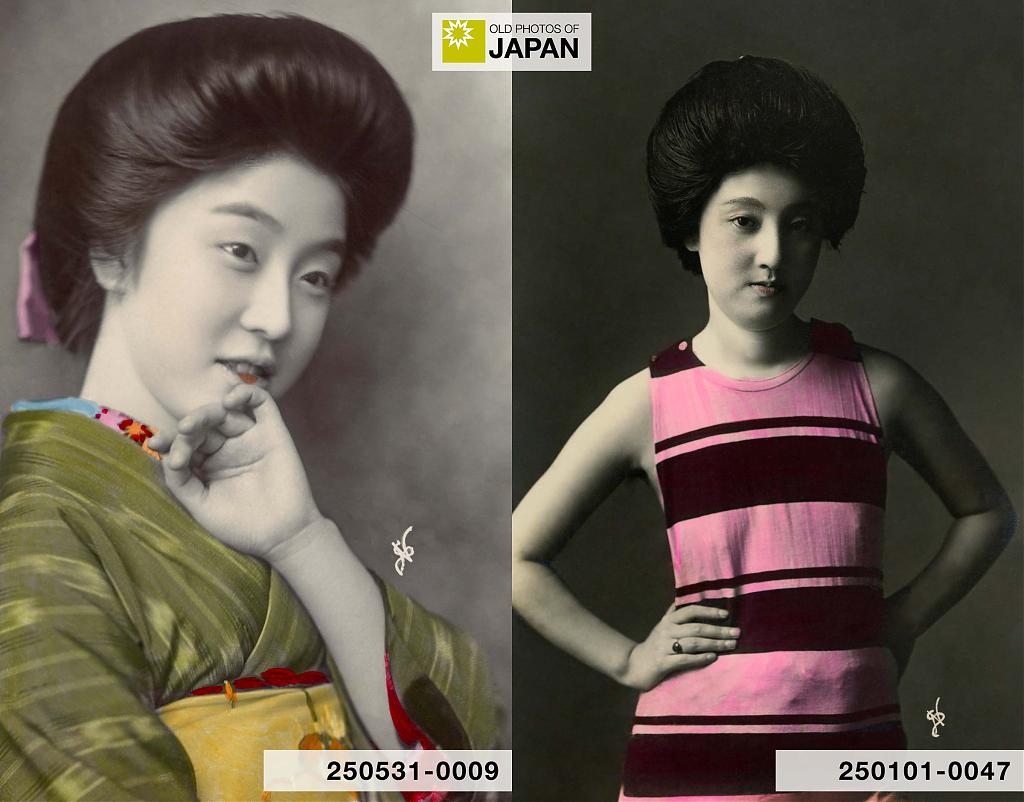
During the 1910s, Shitaya’s geisha district counted 348 geisha and maiko in 139 okiya (geisha houses).2 Three of Shitaya’s geisha achieved national fame. One of them, Sakae (栄え), became a popular postcard model and posed in bathing suits.
Ueno was a diverse and almost bohemian place, full of energy and dreams. It was a meeting place, but also a window, and a gate. It was a place of art and beauty, and a place where new ideas were forged over luscious food and drink, while graceful geisha entertained with music, song, and dance. It was a place of lotus, silk, and sake. A place to sate the senses.
Bringing Shitaya Back
For such a vibrant district, surprisingly little is known about what it was like or who worked there. Ueno appears frequently in historical materials, but most images and descriptions focus on the park. The entertainment and commercial area in front of it was largely overlooked. Even photographs and illustrations are rare.
The restaurants were mentioned in culinary guides, and geisha houses and the venues where geisha worked appeared in directories. However, most of this has been forgotten. I could not even find a map of the shops and restaurants.
As a result, you have likely never read accounts about Ueno before the 1923 earthquake, nor have seen many images of the area from that time. Many people today are even unaware that this district was once known as Shitaya.
Following my work on Ueno’s forgotten racetrack, I was about to move on to the origins of British-style horse-racing in Japan. However, to bring this lost chapter of Tokyo’s history back into view, I decided to remain with Ueno a little longer.
Over the past three months, I have dug deep into newspapers, magazines, books, directories, credit registers, and even court records from the late 1800s through early 1900s. I have consulted hundreds of primary sources.
So far, I have identified more than 300 addresses, allowing me to reconstruct a map of the shops, restaurants, and other businesses that once stood in front of Ueno Park. While I have cross-checked records from multiple decades, my primary focus has been on what the area looked like on the eve of its destruction.
I have uncovered compelling firsthand accounts and stories. In some cases, the data tells its own story. Of the roughly 240 businesses identified so far, about 30 percent were owned or managed by women. One is hard pressed to find an area in Japan today with such a high percentage.
There is still much to be done. I am currently building an interactive map to visualize Ueno as it appeared a century ago. To complete it, I need to locate about 100 additional addresses. Newly acquired images must be scanned and edited, and a substantial body of material remains to be read and translated. The articles themselves are still to be written.
Had I known at the outset how demanding this project would be, I might not have embarked on it. But having uncovered so much fascinating material, I am very glad that I did. I hope this work will contribute meaningfully to our understanding of what kind of city Tokyo used to be.
Thank you for your patience as I complete this research. If you have considered supporting this work, but did not feel quite ready yet, now would be an excellent time to do so.
Support this research with a donation.
If you live in Japan or Europe, you can also donate directly via bank transfer. This avoids high processing fees and ensures the full amount reaches me promptly. Please contact me for details.
Continue to Part 2: A Castle in a Marsh.
Notes
1 Fujimoto, Taizo (1917). The Story of the Geisha Girl. London: T. Werner Laurie, 25.
2 ibid, 24, 25.
Published
Updated
Reader Supported
Old Photos of Japan aims to be your personal museum for Japan's visual heritage and to bring the experiences of everyday life in old Japan to you.
To enhance our understanding of Japanese culture and society I track down, acquire, archive, and research images of everyday life, and give them context.
I share what I have found for free on this site, without ads or selling your data.
Your support helps me to continue doing so, and ensures that this exceptional visual heritage will not be lost and forgotten.
Thank you,
Kjeld Duits
Reference for Citations
Duits, Kjeld (). Tokyo 1920s: Ueno before the Quake, OLD PHOTOS of JAPAN. Retrieved on October 15, 2026 (GMT) from https://www.oldphotosjapan.com/photos/995/ueno-forgotten-golden-age-shinobazu-restaurants-geisha-1910s


There are currently no comments on this article.