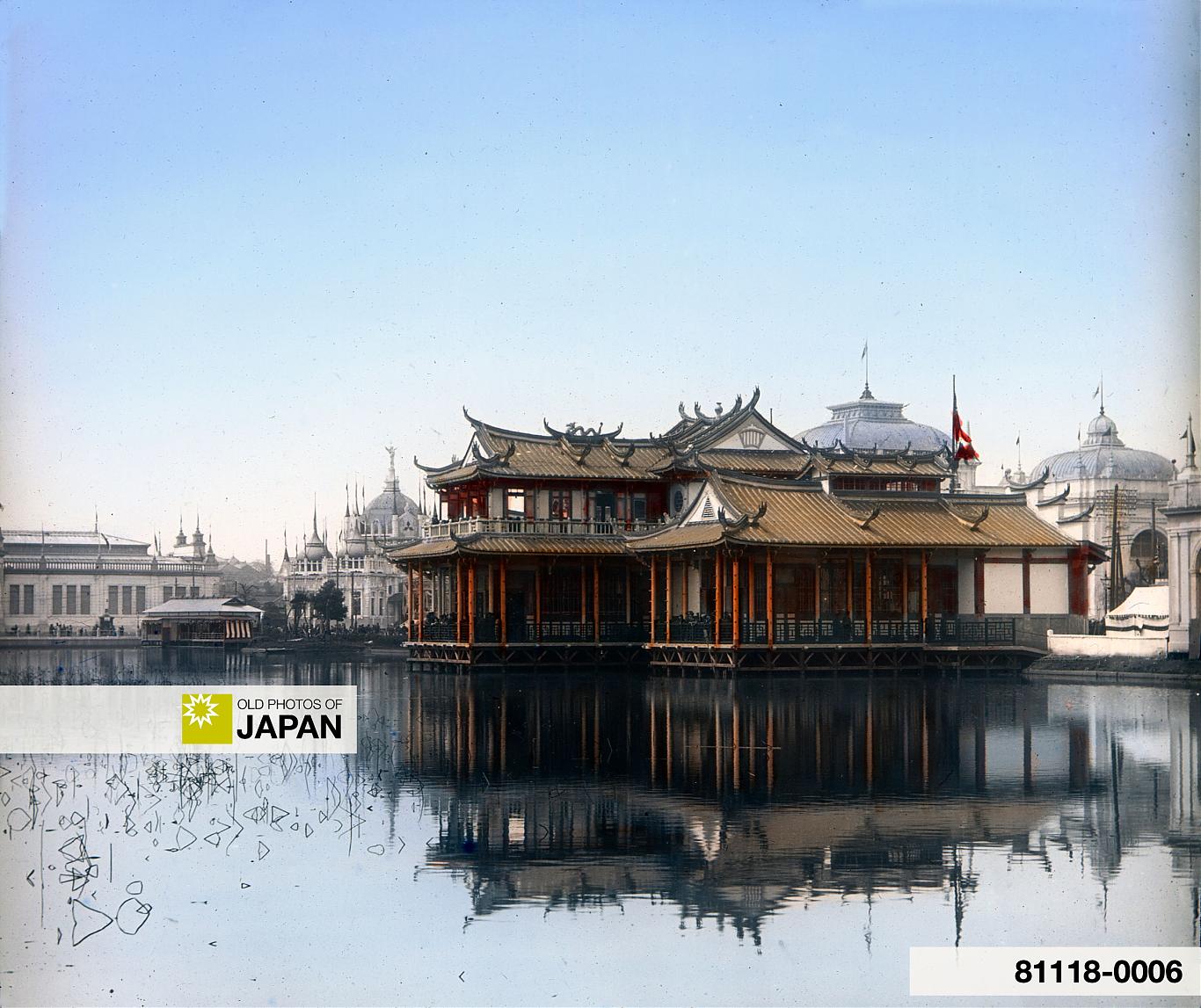
The 1907 Tokyo Industrial Exhibition’s ornate buildings stand where the grandstand of the Shinobazu Horse Racetrack once stood at Tokyo’s Ueno Park. Its sober traditional architecture replaced by the vibrant Taiwan Pavilion and an eclectic Westernized architecture.
This is Part 3 in a series of three articles about the Ueno Race Track.
Introduction
This is the third article in a series about horse racing at Ueno Park. In 1884 (Meiji 17), a racetrack was opened around Shinobazu Pond, famed for its lotus flowers. Although it was Japan’s most important racetrack in what is arguably Tokyo’s most prominent park, today few people know it existed.
The previous two articles introduced the racetrack, the project’s objectives, Ueno Park’s powerful symbolism to understand why the racetrack was established there, and how the track changed Shinobazu Pond.
In Part 3, we discover the track’s fate.
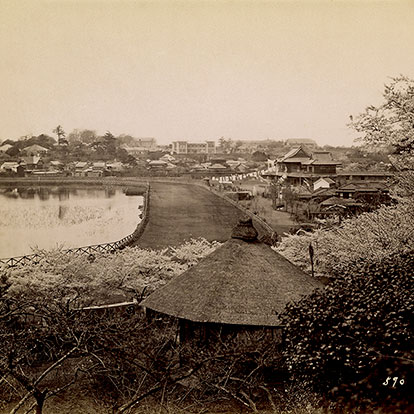
Tokyo 1880s
The Forgotten Horse Races of Ueno Park (1)
Today, people visit Shinobazu Pond in Tokyo’s Ueno Park to quietly admire its magnificent lotus flowers. But for a brief period in the past, crowds gathered here to watch exciting horse races, brilliant spectacles that were carefully designed to craft a national identity.
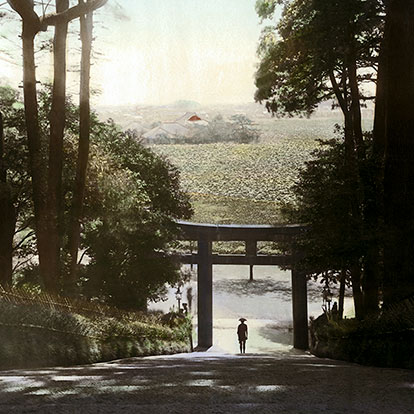
Tokyo 1880s
The Forgotten Horse Races of Ueno Park (2)
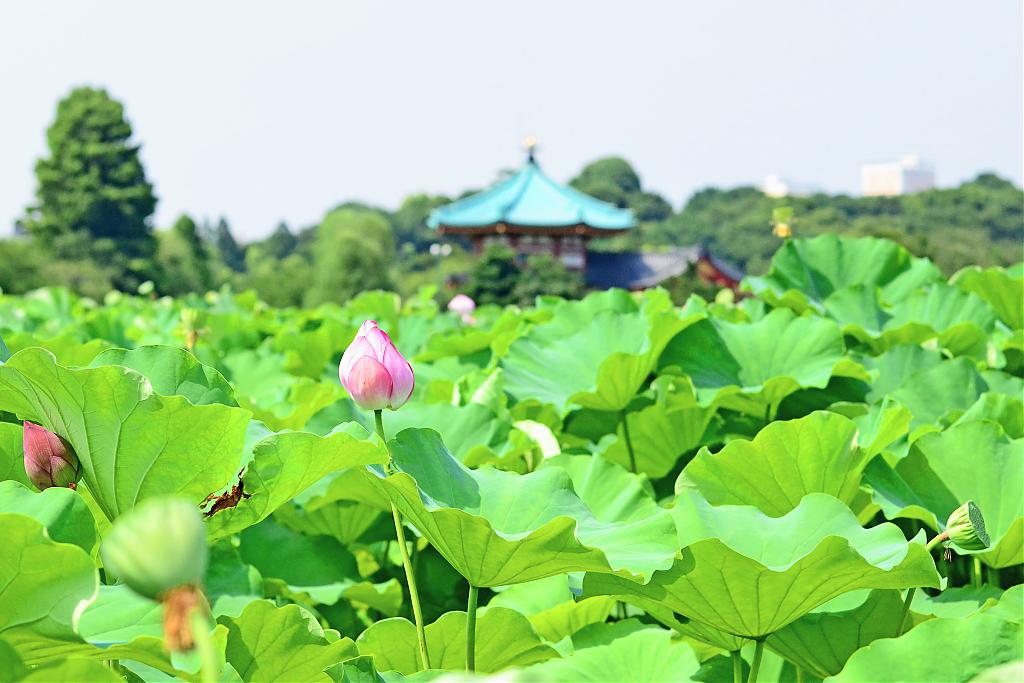
A spectacular view of thousands of lotus flowers surrounding Bentenjima Island in Shinobazu Pond. From 1884 to 1892, the pond was the location of Japan’s most important horse racing track, strongly supported by Emperor Meiji and the government.
The End of an Era
From the very beginning of its founding in 1879, the Union Race Club had trouble financing its activities. It was not allowed to sell betting tickets, and membership fees and admission fees were totally insufficient to cover expenses. It therefore depended heavily on grants from the emperor and support from the Imperial Household Ministry, the Ministry of Agriculture and Commerce, and the army. This support reached its limits by the early 1890s.
Simultaneously, the government’s excessive Westernization policies started encountering severe backlash from around 1887 (Meiji 20). With popular interest for horse racing gradually fading away, Shinobazu’s last races were held in autumn 1892 (Meiji 25).31
In 1893, only a few years after Crawford Fraser wrote her vivid description of Shinobazu Pond (see Part 2), the Union Race Club was dissolved. The “grassy road” that she had admired on a beautiful summer’s day in 1889 would no longer be torn up by horses’ hooves. In 1895 (Meiji 28), newspapers announced the grandstand’s auction. Soon after, it was torn down to make way for a road.32
Auction of the Shinobazu Grandstand
The Shinobazu Pond grandstand attached to the Union Race Club is to be sold, as it lies on land designated for a new road under the city improvement plan. The property will be put up for auction on the first day of next month.
The same fate awaited other racetracks. By 1899 (Meiji 32), almost all racetracks in Tokyo’s metropolitan area had closed.33 An era had come to an end.
The poem Shinobazu, written by Japanese poet Shiki Masaoka (正岡子規, 1867–1902) in 1896, suggests that Shinobazu was a sad place around this time.34 It describes the lost glory of the pond during an early winter’s evening.
With carefully chosen words, the kanshi poem paints a picture of the fading light of the setting sun and ducks fighting over sparse weeds hidden in the frozen water. On one side, the outline of the encroaching city is pushing against the pond, on the other is the shadow of Ueno Park’s elevated and forested plateau. In between, the pond feels small.
The age of the Buddhist Bentendo temple on the pond’s island shows, and the wooden fence of the old racetrack appears to be close to crumbling.
Shiki’s readers would have been familiar with the restaurants and teahouses that lined the pond. His poem mentions the sounds of musical instruments and singing leaking from them and wafting over the quiet waters of the pond. It must have created an unattainable feeling of wistfulness.
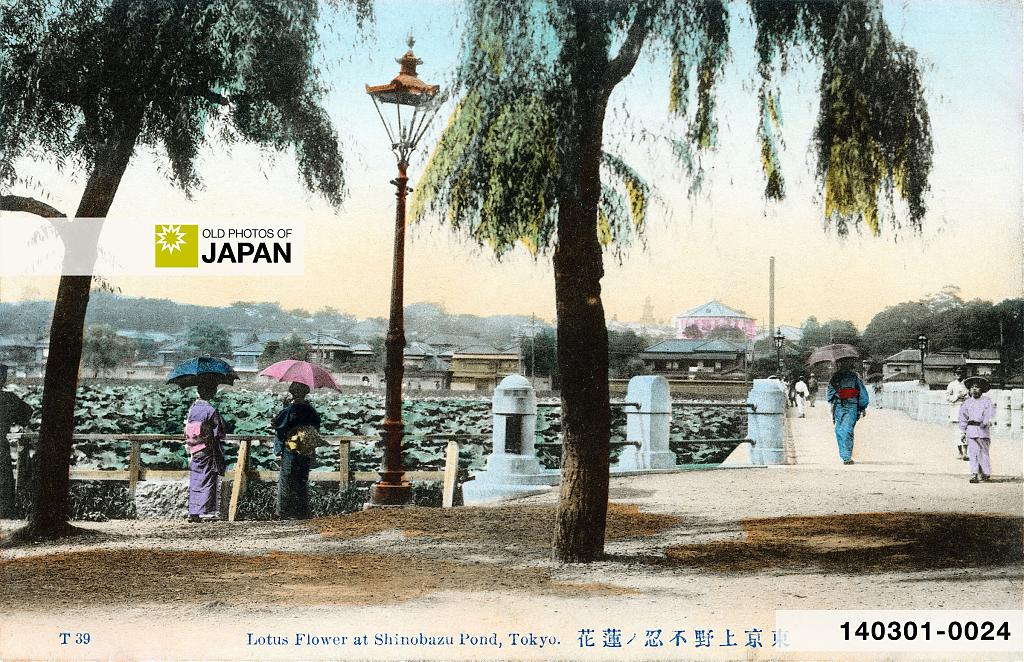
A postcard from a few years later offers a more uplifting view of the pond. It is summer. Women are sheltering from the sun under parasols, admiring the lotus flowers that cover the pond. In the background, the city reaches to its very edge. The park’s forested plateau rises up out of view behind the photographer.
Into the Future
After the racetrack closed, Shinobazu Pond continued to be used to bring in the modern world. In 1898 (Meiji 31), a domestic and international bicycle racing event was held here.35 Japan’s first motor race took place at Shinobazu in 1901 (Meiji 34), with three gasoline-powered motor vehicles racing around the pond.36 And in 1909 (Meiji 42), Japan’s first certified fixed-wing aircraft flight took place here.37
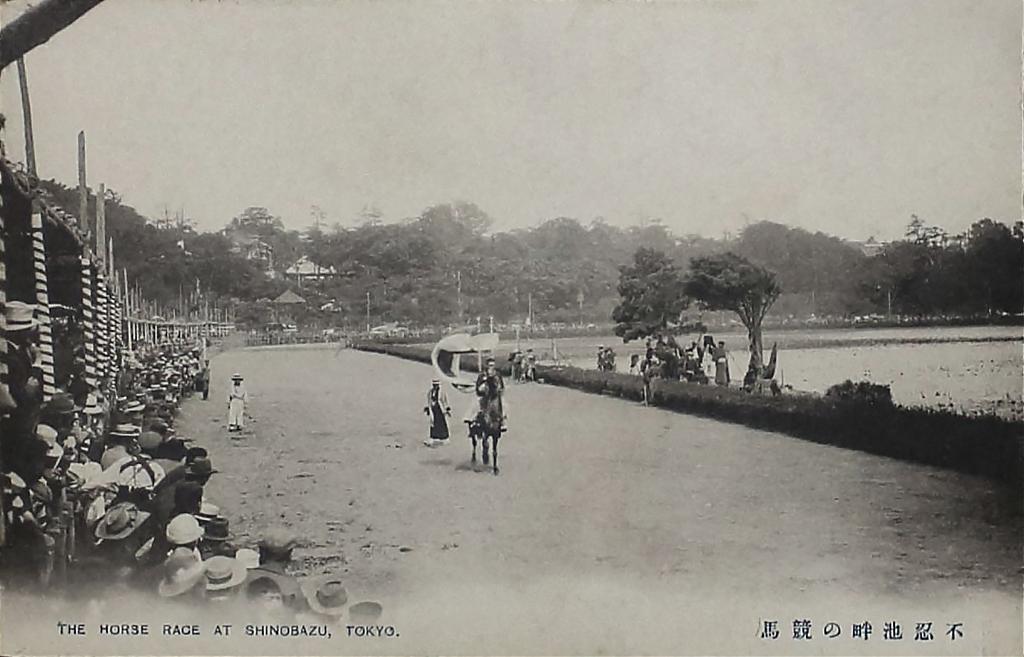
In between, horses once more raced around Shinobazu. In May 1906 (Meiji 39), several racing associations collaborated to organize the Kantō Horse Racing Tournament (関八州競馬大会, Kanhasshū Keiba Taikai).38 The Tokyo Nichinichi Shimbun reported that the races, which took place from May 19 through 21, attracted an enormous crowd:39
At the foot of the stone steps to Tōshō-gū Shrine, a horse-viewing stand constructed by a decorating company was installed, where anyone could enter upon purchasing a ticket for fifty sen. Several other temporary viewing stands were also observed, all of which had attracted considerable crowds since the morning. As a result, the number of spectators filling Ueno Hill and its stone stairways was beyond counting, reaching into the tens of thousands. Restaurants, machiai [a type of teahouse], and rental seating establishments facing the pond, such as Sakurakan and Mukyokutei, extended matting and laid carpets to receive guests. Anticipating the great crowds, food vendors and toy sellers lined the streets without a gap, creating a lively bustle throughout the entire area from Hirokōji to the edge of the pond.
The three days of racing included riders in samurai armor and demonstrations of traditional equestrian techniques, such as horohiki (母衣引), a ritual in which a 10-meter-long pennant tied to the rider’s back is slowly unfolded as the horse increases speed. Among the four horohiki riders were a fifteen-year-old boy and an eighteen-year-old woman, the daughter of a well-known riding instructor.40
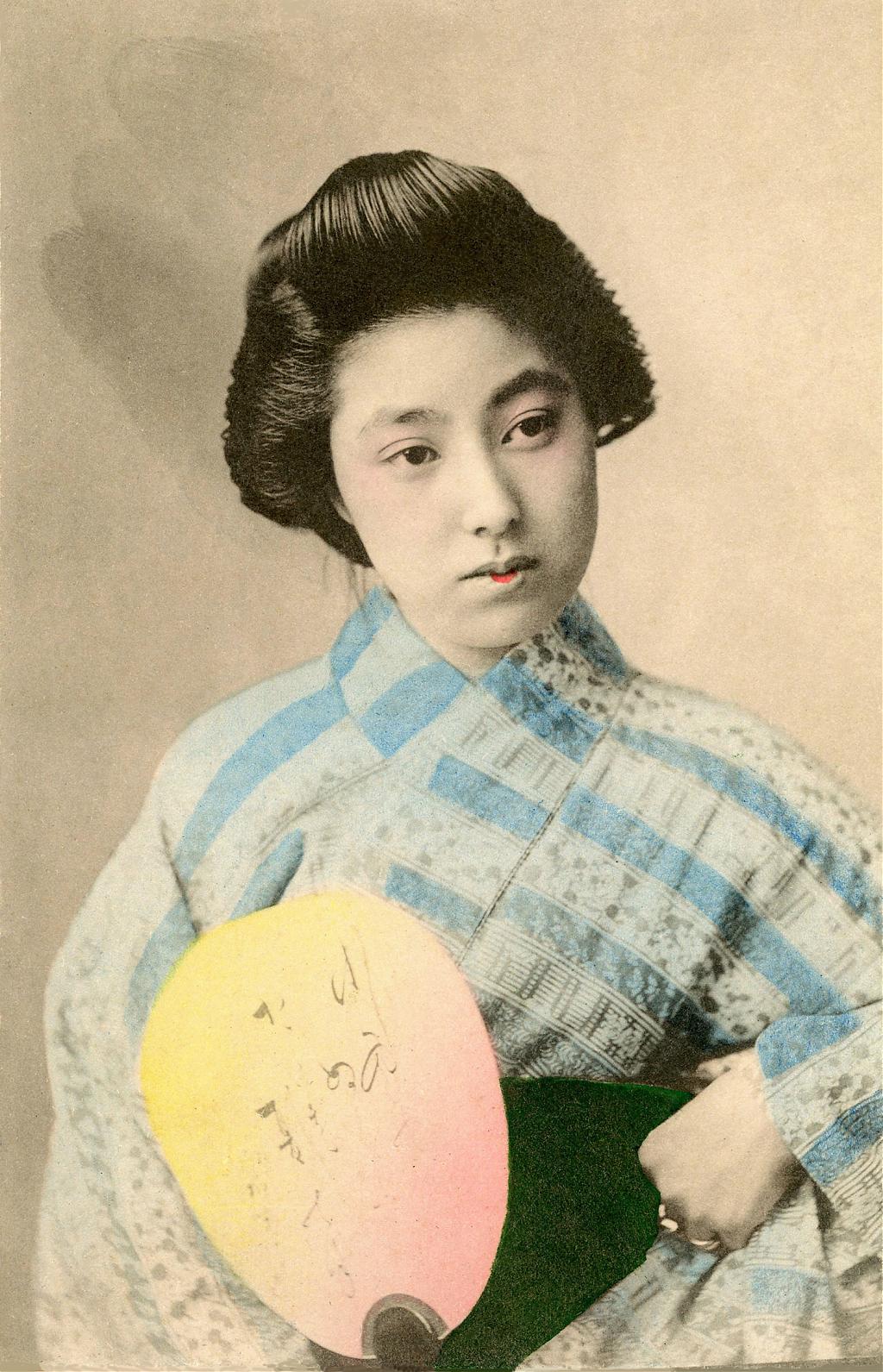
There were more women participating in the event. At least six geisha from the Asukasu Park geisha district registered for the races, ranging in age from fifteen to twenty-one years old. Among them was the twenty-one-year-old Koen (小ゑん) of the geisha house Masuya (树谷). At the time, she was well-known as a bijin ehagaki (美人絵葉書) postcard model and her name appeared in the gossip columns.41
Sadly, the Tokyo Nichinichi Shimbun reported that the geisha event was cancelled on the first day due to objections raised by the judges. It is unclear if they were allowed to race another day. But there is a photo of Koen riding a horse at the event. Additionally, the daughter of the riding instructor and the geisha O-Fune (お舟) performed a riding demonstration on the second day.42
Intriguingly, The Kokumin Shimbun reported on May 18 that “several daughters of good families” would compete anonymously.43 It is not known if they did. They would never again have the opportunity. The 1906 horse races were the very last ones that took place at Shinobazu.
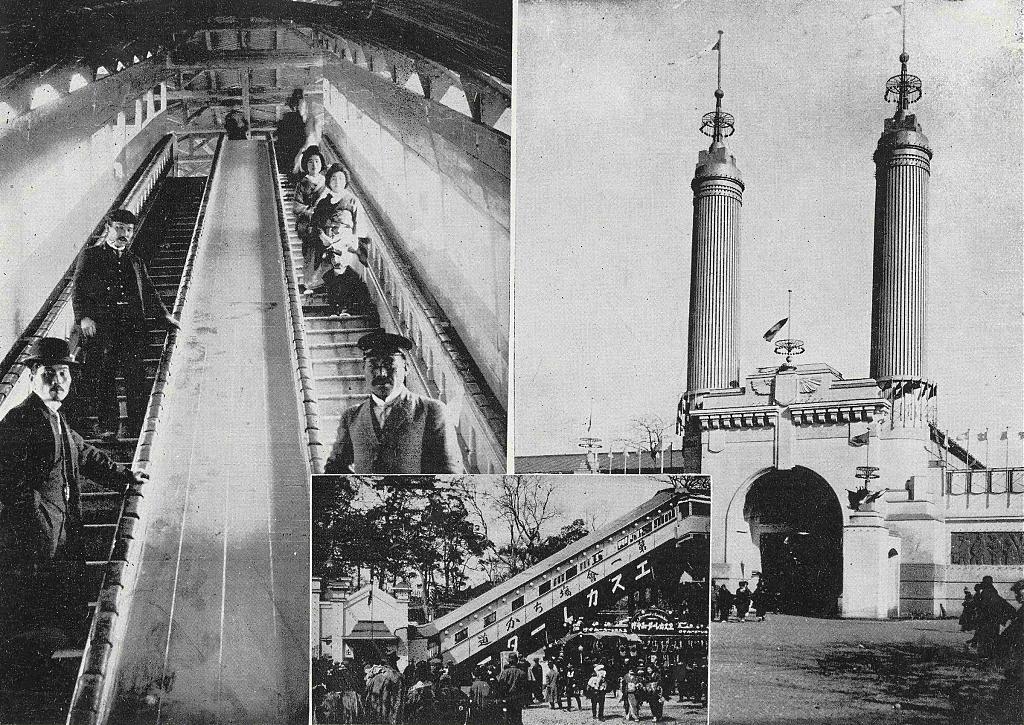
After the tournament, Ueno Park hosted three more large exhibitions showcasing the latest inventions. The 1907 (Meiji 40) Tokyo Industrial Exhibition featured modern attractions such as a water chute and a Ferris wheel, as well as a traditional Taiwanese Pavillion to illustrate Japan’s new role as a colonial power. The Tokyo Taisho Exhibition of 1914 (Taishō 3) focused on electricity, introducing items such as Japan’s first escalators and cable car.
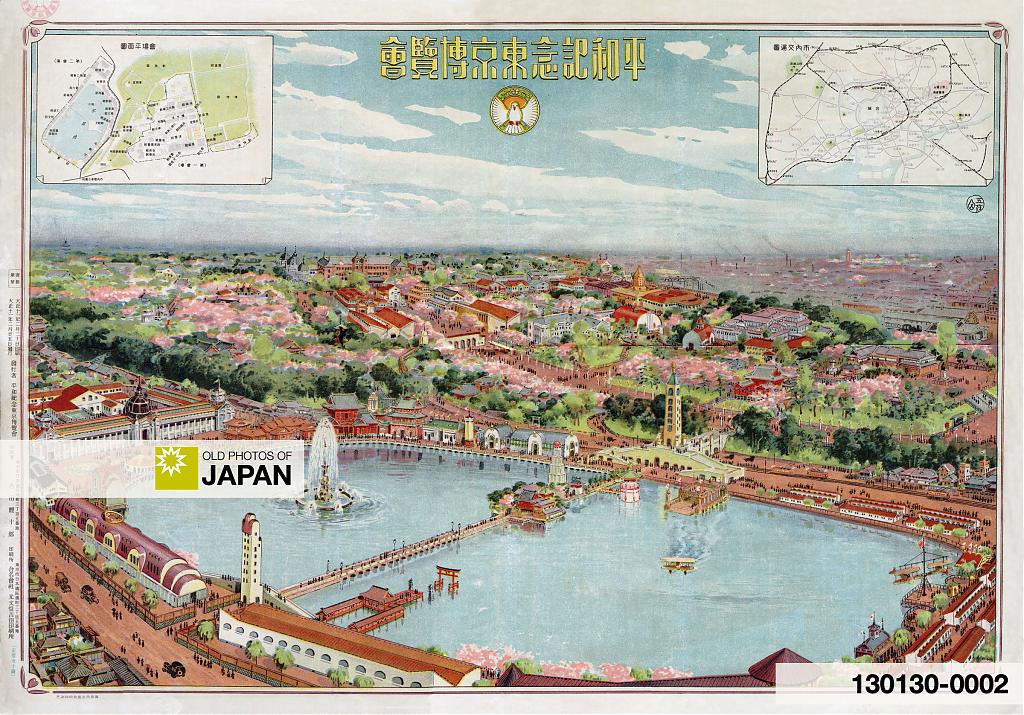
The Peace Commemorative Tokyo Exposition, held in 1922 (Taisho 11), celebrated peace after World War I. The star attraction were planes, which had come into their own during the conflict, operating on Shinobazu Pond. Over 11 million people visited when Japan’s population was 56.7 million.
Forty-five years after the First National Industrial Exhibition had been held at Ueno Park, and thirty-eight years after the first horse races there, Japan had conclusively arrived on the world stage. The Meiji leaders’ goals had been more than achieved. Japan was a global power. The exhibition guide called the event “a microcosm of the new Japanese civilization.”44
| Year | Exhibition | Visitors |
|---|---|---|
| 1877 | First National Industrial Exhibition 第1回内国勧業博覧会 (Dai 1-Kai Naikoku Kangyō Hakurankai) |
454,168 |
| 1881 | Second National Industrial Exhibition 第2回内国勧業博覧会 (Dai 2-Kai Naikoku Kangyō Hakurankai) |
822,395 |
| 1890 | Third National Industrial Exhibition 第3回内国勧業博覧会 (Dai 3-Kai Naikoku Kangyō Hakurankai) |
1 million |
| 1907 | Tokyo Industrial Exhibition 東京勧業博覧会 (Tōkyō Kangyō Hakurankai) |
6.8 million |
| 1914 | Tokyo Taisho Exhibition 東京大正博覧会 (Tōkyō Taishō Hakurankai) |
7.5 million |
| 1922 | Peace Commemorative Tokyo Exposition 平和記念東京博覧会 (Heiwa Kinen Tōkyō Hakurankai) |
11 million |
Ueno Park Today
The devastating Great Kanto Earthquake of 1923 (Taisho 12) heralded the end of large exhibitions at Ueno Park. In 1928 (Showa 3), one more exhibition was held, the Tokyo Exhibition for Encouragement of National Industries in Commemoration of the Ceremony of Enthronement (大礼記念国産振興東京博覧会). But it attracted only 2.23 million visitors, a fraction of the preceding three exhibitions.
The focus was shifted toward permanent cultural, educational, and museum infrastructure, a policy still maintained today. Ueno Park now boasts the highest concentration of museums in Japan, serving as its premier location for cultural, scientific, and art institutions. Shinobazu’s lotus flowers are still there, offering beauty and serenity, as they have for ages.
Forgotten Figures
There is an unsolved mystery hiding behind the story of the Shinobazu Racetrack. Who built it? Their names are Kunitarō Kuga (久我邦太郎) and Denzō Haruyama (春山伝蔵). It is even known that Emperor Meiji was so impressed by their work that he granted them an audience on the opening day of the first races in 1884.45
However, beyond their names, very little is known about them. Will this mystery ever be solved?
I am now tracing the origins of British-style horse racing in Japan. Stay tuned!
Thank You!
Last month I made an appeal for support in the newsletter Three Extremely Rare Images. I wrote that I discovered several rare prints during my research about the horse racetrack at Ueno Park, but that serious health issues over the past three years exhausted my funds, preventing me from purchasing them.
I described one of these images, an 1863 engraving based on long lost photos, showing the first British-style racetrack in Japan, built before Yokohama’s famous Negishi track. Thanks to the support of the Old Photos of Japan community I was able to purchase this print.
Read more about this historical print in Thanks for the Latest Acquisition.
This rescue project is funded by readers like you
Old Photos of Japan provides thoroughly researched essays and rare images of daily life in old Japan free of charge and advertising. Most images have been acquired, scanned, and conserved to protect them for future generations.
I rely on readers like you to keep this online museum going.
Ueno’s Forgotten Windmill
Discover one more extremely rare photo of Ueno Park in this article from 2018:
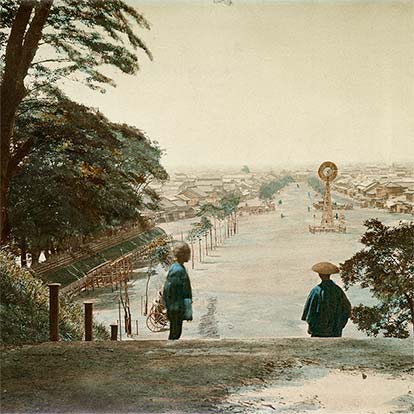
Tokyo 1870s
Windmill at Ueno-Hirokoji
When I purchased this albumen print, I only knew that this was somewhere in Tokyo. I didn’t know if the photo was significant. Research revealed some surprises.
| TIMELINE | |
|---|---|
| Toyama Racetrack | |
| 1879 | Western-style horse races are held at Toyama to welcome former U.S. President Grant. Emperor Meiji attends. Soon after, the Union Race Club is established. |
| 1884 | The Union Race Club holds the last races at Toyama before moving to Ueno Park. |
| Shinobazu Racetrack | |
| 1884 | November 1–3: The first races are held at the Shinobazu Racetrack. From 1885, races are held every May and November |
| 1890 | Special racing events are held at Shinobazu in conjunction with the Third National Industrial Exhibition. |
| 1892 | Last races held at Shinobazu under the auspices of the Union Race Club. |
| 1893 | The Union Race Club is disbanded. |
| 1895 | The Shinobazu Grandstand is torn down to make way for a road. |
| Models of Modernity | |
| 1898 | A bicycle racing event is held at the former Shinobazu horse racetrack. |
| 1901 | Three gasoline-powered vehicles race around the former Shinobazu horse racetrack. |
| 1906 | Horse races for the Kanto region are held on the former Shinobazu Racetrack ( 関八州競馬会). These are the last horse races to ever take place here. |
| 1907 | The Tokyo Industrial Exposition (東京勧業博覧会) is held, featuring modern attractions such as a water chute and a Ferris wheel. |
| 1909 | Japan's first certified fixed-wing aircraft flight takes place at Shinobazu. |
| 1914 | The Tokyo Taisho Exhibition is held. It features Japan’s first cable car, powered by electricity. |
| 1922 | The Peace Commemorative Tokyo Exposition (平和記念東京博覧会) is held to celebrate peace after World War I. A seaplane operates on Shinobazu Pond. |
Acknowledgements
I owe thanks to the following people for the assistance they gave and the information and images that they shared:
- The librarians of the Tokyo Metropolitan Central Library and the National Diet Library.
- Ivo Smits, professor of Arts and Cultures of Japan at Leiden University in the Netherlands for his introduction and translation of a poem about Shinobazu Pond by Japanese poet Shiki Masaoka (see note 34 below).
- Kosaku Tauchi (田内昂作). His site Horse Racing Stamp has a page with very rare postcards of the 1906 tournament that helped enormously and inspired me to search harder.
- Helen Thiselton, aka Blue Ruin 1 on Flickr, for her feedback and allowing me to publish her postcard of the geisha Koen in this article.
Notes
31 ⾼橋⼀友 (2018). 『[論説] 明治天皇と競⾺ —近代⽇本における⾺概念の変容—』 社会システム研究, 21: 147.
The last races held at Shinobazu by the Union Race Club took place on May 7-8 and November 19-20, 1892.
32 新聞集成明治編年史編纂会 (1940)『新聞集成明治編年史 第九卷』林泉社, 195.
January 23, 1895 (Meiji 28):『不忍池馬見所を競賣』「〔一・二三、國民〕共同競馬會社の附屬不忍池馬見所は、市内改正の道路に當るを以て之を賣却する事となり、來月一日競賣に附す。」
33 ⾼橋⼀友 (2018). 『[論説] 明治天皇と競⾺ —近代⽇本における⾺概念の変容—』 社会システム研究, 21: 148, 149.
34 Many thanks to Ivo Smits, professor of Arts and Cultures of Japan at Leiden University in the Netherlands, who introduced me to this beautiful poem on his Dutch language blog about Japanese poetry and sent me his English translation.
不忍池
小湖開郭裏。勝概寄邱陵。飢鴨群争藻。枯荷折入氷。
弁財祠漸古。調馬埒将崩。隔水絃歌動。夕陽既上燈。
正岡子規 (1926). 『子規全集 第6巻 (和歌)』アルス, 688.
Shinobazu Pond
A little lake lies stretched out behind a brothel;
this ‘splendid view’ is propped against the hills.
A flock of hungry ducks fights over water weeds;
stalks of withered lotuses are sunk into the ice.
The shrine to Benzaiten grew ever older;
the racetrack fence is just about to crumble.
Beyond the water, music stirs the heart;
the evening sun by now is up there shining.
Translation by Ivo Smits
Masaoka, Shiki; Smits, Ivo (2021). houtrot in moderniserend Japan. penseelvanwind. Retrieved on 2026-02-01.
35 内外連合自転車競走運動会『自轉車競走運動會』 風俗画報 第178号 明治31年12月10日
36 鈴木 一義 (2000) 『20世紀の国産車: 高嶺の花がマイカーとなるまで』三樹書房, 50.
Three gasoline-powered vehicles, one with two wheels, one with three wheels, and one with four wheels, raced around Shinobazu Pond.
37 Suzuki, Shinji (2012). Japanese aviation still soaring after a century. A trailblazer in the country’s aeronautics, the University of Tokyo continues its pioneering R&D role today. University of Tokyo. Retrieved on 2025-12-20.
The flight took place on December 9, 1909. A car towed the glider while driving along a street near Shinobazu Pond. The glider was piloted by French Navy officer and inventor Yves Paul Gaston Le Prieur (1885–1963).
38 関八州 (Kanhasshu) is an abbreviation of 関東八州 (Kantō Hasshu). The term refers to the eight Edo-period provinces of Kantō: Sagami, Musashi, Awa, Kazusa, Shimōsa, Hitachi, Kōzuke and Shimotsuke. These days, the term Kantō is used.
39 日本競馬史編纂委員会 (1967)『日本競馬史 第2巻』日本中央競馬会, 66.
「東照宮石段下には装飾会社建設の馬見台ありて、一人金五十銭の入場券を購えば何人も見物し得べく、他にも二、三の掛模敷を見たるが、いずれも午前中よりかなり観客ありき。したがって上野山上、同石段等に充満せる観客はその幾万なるを知らず、池に面する桜館、無極亭その他の飲食店、待合、貸席等は横敷を張出し毛艶を敷きて客を迎え、また当日の人出を当て込みに飲食店、玩具商等隙間なく店を列ねて広小路より池の端附返すべて一帯に賑いたり。」
40 ibid, 67.
新聞集成明治編年史編纂会 (1940) 『不忍競馬に婦人出馬』(國民新聞, 明治39年5月18日)『新聞集成明治編年史 第十三卷』林泉社, 93.
The 15-year-old boy was Shōnosuke Yomo (四方正之助) and the 18-year old woman was Tatsuko Nakane (中根多津子), the daughter of the then well-known riding instructor, Nosuke Nakane (中根之助).
The horohiki ritual is still performed at Japan Racing Association (JRA) events today.
41 The information about Koen has been compiled from the following sources:
- 日本競馬史編纂委員会 (1967)『日本競馬史 第2巻』日本中央競馬会, 69.
- 新聞集成明治編年史編纂会 (1940) 『不忍競馬に婦人出馬』(國民新聞, 明治39年5月18日)『新聞集成明治編年史 第十三卷』林泉社, 93.
- 團團珍聞 (明治36年6月27日)
- 文芸倶楽部 第12巻第1号 (明治39年)
- 文芸倶楽部附録 日本百美人 (明治41年)
Bijin ehagaki, literally beauty postcards, are postcards with photos of beautiful women, generally geisha. They were extremely popular in the first decades of the 20th century. They are the precursor of today’s photo prints of famous celebrities, idols, and actors that are known as buromaido (ブロマイド) in Japan.
42 日本競馬史編纂委員会 (1967)『日本競馬史 第2巻』日本中央競馬会, 71.
「右についで中根たつ子および浅草芸伎清の家お舟二人の地乗あり。」
43 新聞集成明治編年史編纂会 (1940) 『不忍競馬に婦人出馬』(國民新聞, 明治39年5月18日)『新聞集成明治編年史 第十三卷』林泉社, 93.
44 東京大正博覧会案内編輯局 (大正3)『東京大正博覧会観覧案内』文洋社, 3.
「新日本文明の縮圖」
45 立川健治 (2008).『文明開化に馬券は舞う : 日本競馬の誕生』世織書房, 10.
Published
Updated
Reader Supported
Old Photos of Japan aims to be your personal museum for Japan's visual heritage and to bring the experiences of everyday life in old Japan to you.
To enhance our understanding of Japanese culture and society I track down, acquire, archive, and research images of everyday life, and give them context.
I share what I have found for free on this site, without ads or selling your data.
Your support helps me to continue doing so, and ensures that this exceptional visual heritage will not be lost and forgotten.
Thank you,
Kjeld Duits
Reference for Citations
Duits, Kjeld (). Tokyo 1907: The Forgotten Horse Races of Ueno Park (3), OLD PHOTOS of JAPAN. Retrieved on October 23, 2026 (GMT) from https://www.oldphotosjapan.com/photos/994/the-forgotten-horse-races-of-ueno-park-3
There are currently no comments on this article.