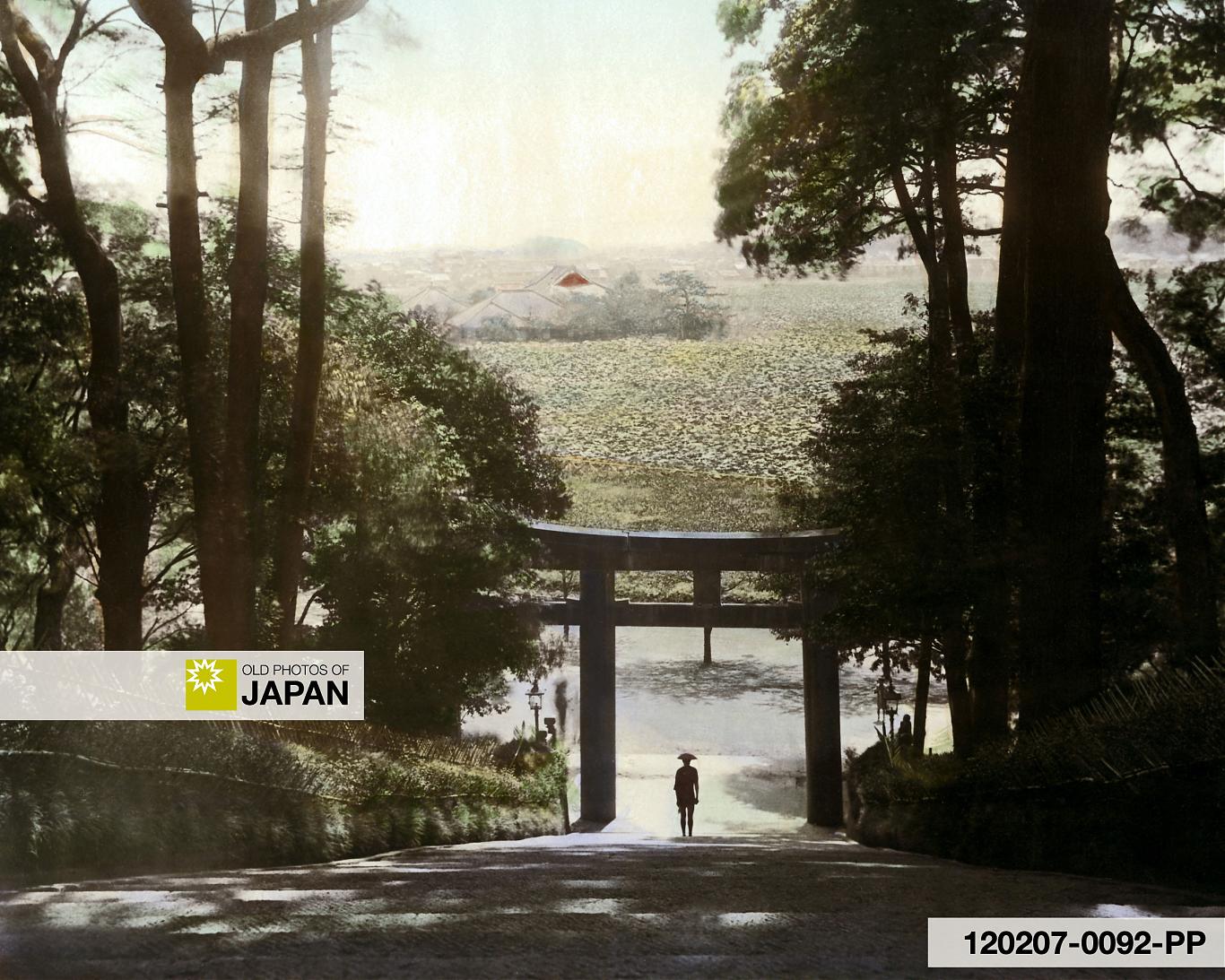
A spectacular view of thousands of lotus flowers surrounding Bentenjima Island in Shinobazu Pond. From 1884 to 1892, the pond was the location of Japan’s most important horse racing track, strongly supported by Emperor Meiji and the government.
This is Part 2 in a series of three articles about the Ueno Race Track.
This rescue project is funded by readers like you
Old Photos of Japan provides thoroughly researched essays and rare images of daily life in old Japan free of charge and advertising. Most images have been acquired, scanned, and conserved to protect them for future generations.
I rely on readers like you to keep this online museum going.
Introduction
This is the second article in a series about horse racing at Ueno Park. In 1884 (Meiji 17), a racetrack was opened around Shinobazu Pond, famed for its lotus flowers. Although it was Japan’s most important racetrack in what is arguably Tokyo’s most prominent park, today few people know it existed.
Part 1 introduced the racetrack, its magnificent grandstand, and the project’s two main objectives: projecting Japan as a “civilized nation” and preparing for war.
There also was an unstated third objective: transforming Japan into a nation-state. The races at Ueno were ultimately designed to visualize the emperor and help cultivate the new national identity centered on him.
In Part 2, we look at Ueno Park’s powerful symbolism to understand why the racetrack was established there and how it altered Shinobazu Pond.
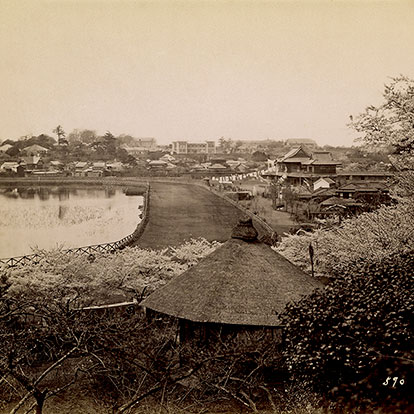
Tokyo 1880s
The Forgotten Horse Races of Ueno Park (1)
Today, people visit Shinobazu Pond in Tokyo’s Ueno Park to quietly admire its magnificent lotus flowers. But for a brief period in the past, crowds gathered here to watch exciting horse races, brilliant spectacles that were carefully designed to craft a national identity.
Imperial Myth-Making
To help cultivate a new national identity centered on Emperor Meiji, the Union Race Club, which organized the horse races at Shinobazu, created an elaborate imperial spectacle around the races.
Ueno Park was an ideal setting for imperial myth-making. First of all, it was easily accessible. Nearby Ueno Station opened a year before the racetrack, in 1883 (Meiji 16). Furthermore, the Tokyo Horse Tramway, launched in 1882, connected Ueno with the densely populated areas of Shinbashi, Nihonbashi, Kanda, and Asakusa.
Even more important was Ueno’s great symbolism. During the Edo period (1603–1868), Tōeizan Kan’ei-ji stood here. The grand temple complex of over 30 buildings was dedicated to the Tokugawa shōguns. Like Zōjō-ji, it served as a funeral temple; six of the fifteen Tokugawa shōguns were buried at Ueno.
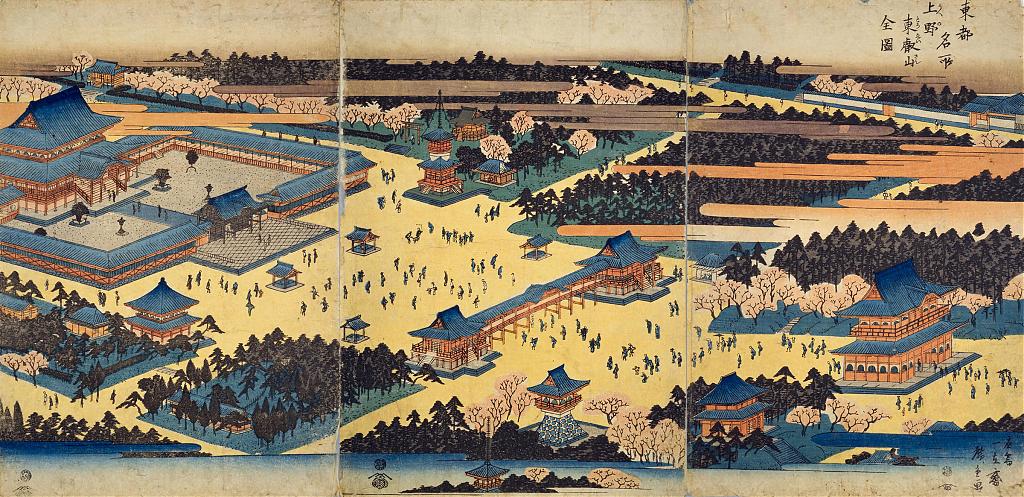
In July 1868 (Keiō 4), 2,000 shogunate soldiers lost a pivotal battle here against 12,000 troops fighting to replace the shogun with the emperor. The Battle of Ueno (上野戦争, Ueno Sensō) marked the end of resistance against the imperial forces in Edo (present-day Tokyo). Most of the temples were completely destroyed by the imperial forces during this battle, adding additional symbolism.
The devastated temple complex was mostly ignored until 1873 when one of Japan’s first public parks was established here. Three years later, the Ministry of Home Affairs started transforming the new park into a prominent cultural district with museums and educational facilities.20
Especially influential was the First National Industrial Exposition held in 1877 (Meiji 10). Organized to promote industrial development, it featured more than 16,000 exhibitors and attracted over 454,000 visitors. Its success led to four more national industrial expositions, two of which were also held in Ueno (1881 and 1890).
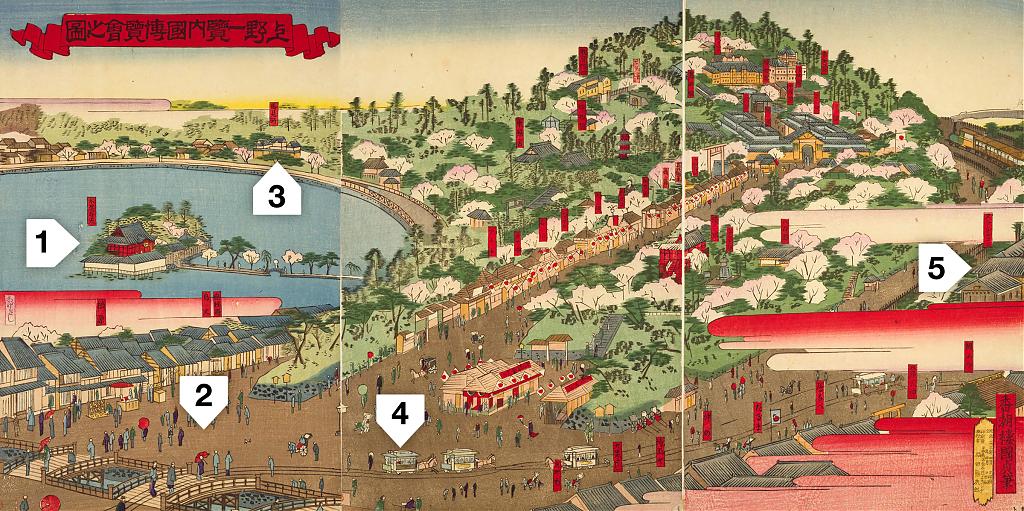
Now things changed at lightning speed. In the same year as the exposition, the National Museum of Nature and Science, then known as the Museum of Education, was established at Ueno Park. In 1879 (Meiji 12), the Japan Academy settled here. The Tokyo National Museum moved to Ueno in 1882 (Meiji 15), and that same year, Ueno Zoo also opened.21
Within a single decade, the Ministry of Home Affairs transformed Ueno into a space for education and socialization with a string of firsts: one of the first public parks, the first museum, the first national exposition, and the first zoo. At the same time, Ueno grew into a stage for imperial ceremonies and national events.
By the time the Shinobazu Racetrack opened, Ueno Park had become a potent symbol of modernization. Through its shared public space, cultural institutions, and newly invented traditions, visitors experienced a new identity as modern citizens aligned with the emerging nation-state. That the park was built on the very ruins of a major Tokugawa temple added to the symbolism.
By strategically placing the racetrack alongside these expositions, museums, and educational facilities, the Union Race Club deliberately turned horse racing into a national project.22 The great expense and spectacle ensured that the message came across loud and clear.
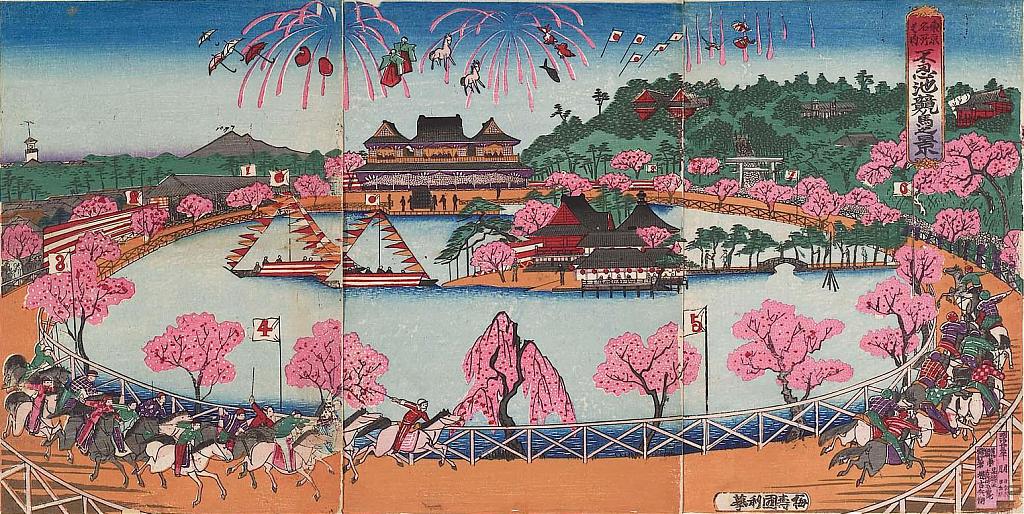
A Beautiful Place
Ueno was renowned for its natural beauty. So, when it became known that a racetrack would be built at Shinobazu Pond, The Japan Weekly Mail predicted that it would “probably be one of the most beautiful in the world.”23 Union Race Club President Prince Komatsu waxed even more lyrically:24
In the first place, this course encircles the waters of the pond; to the east it adjoins Ueno Hill, while to the southwest it is bounded by the outskirts of the city with a single stream marking the limit. To the north, on a broad expanse of land, a grandstand is set up. The length of the track is 880 ken (equivalent to one mile), and its width is twelve ken [22 meters]. It is as though one had obtained a gigantic jade ring and were traveling around the four sides of a bright mirror. Its length and breadth, wide and narrow, all accord precisely with the distances that are the principles of horse racing. Indeed, it seems as if heaven itself created this pond and bestowed upon our country this fine site for the sake of domestic horse breeding. All the more so when one considers that the beauty of its mountains and waters and the elegance of its surroundings truly place it first among all of Tokyo.
Prince Komatsu praised the pond’s beauty, but the racetrack totally changed its character. To create a regular oval shape, a broad band along the pond’s edge was filled in with mud dredged from its center, shrinking the pond significantly. To accommodate the grandstand, the pond’s northwestern section was reclaimed, and a river that flowed into the pond was drained.25
As if to make up for the damage, irises were planted along the new shoreline and willows, cherry trees, and bush clover were planted on the embankment.26
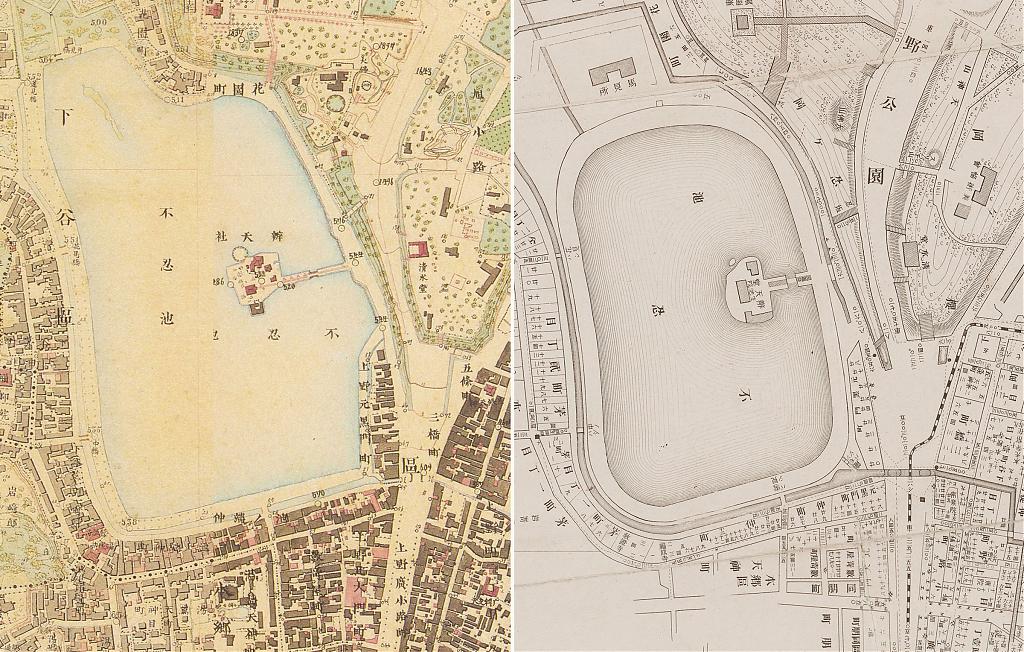
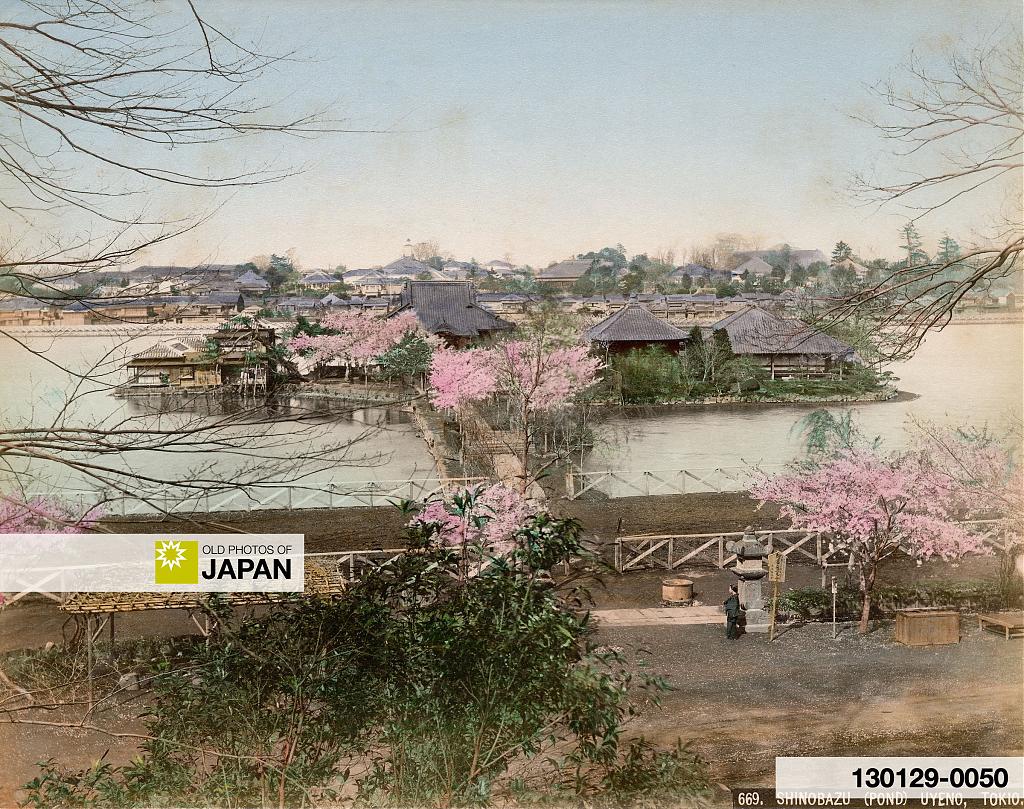
Some criticized the work. British Japanologist Basil Hall Chamberlain (1850–1935) wrote that the “formerly romantic spot” had “fallen to vandalism.”27 British-French architect Josiah Conder (1852–1920), who designed the nearby Tokyo Imperial Museum, felt that the racetrack had “somewhat destroyed [the pond’s] wild and picturesque character.”28 But Japanese journalist Teiichi Miki (三木貞一, 1861–1933) was as enthusiastic as Prince Komatsu:29
Lately they have dredged [Shinobazu Pond], and planted willows upon the edge of it, while a race-course has been made around it, on which two racings are run in a year, one in spring, and the other in autumn: this adds much to the already charming place. The view of the willows weeping in the evening mist, and the sight of the lotus bathing in the morning fog, together with the apperance of flying herons and of floating ducks, are so incomparably beautiful and picturesque, that the pen could do no more than merely hinting at. [sic]

Likely, many people simply accepted the racetrack, as did British author Mary Crawford Fraser (1851–1922). She lived in Japan from 1889 (Meiji 22) to 1894 (Meiji 27) and left us an evocative description of a summer scene at the pond, which she called a lake.
She considered the races, fireworks, and feasting “vulgar and profane,” but loved Ueno Park’s “wise old trees.” Her words reveal that even after the racetrack had utterly altered the landscape, Shinobazu still had much to admire:30
Also that which they call a race-course is a grassy road, running wide and low round the lotus lake, called Shinobazu, where just now myriads of flowers are holding white and rosy cups open to the sun or stars, while their green velvet leaves, a yard wide, lie on the water playing games with round diamond drops that run up and down on the fine veins trying to find their way back to the cool flood below. And all around the lake fly swarms of gorgeous dragon-flies, their burnished bodies and filmy rainbow wings making them seem living jewels as they dart swiftly through the sunshine. The little children, as bright and gay as they, come in bands to the green path round the lake, and fish for the dragon-flies with long fine threads fastened to tall rods of bamboo. These they fling through the air with a sharp whirl, and the long thread winds itself round the dragon-fly, and he is slipped into a fairy cage, and taken home to be fed and petted; but all his free flying is done for ever.
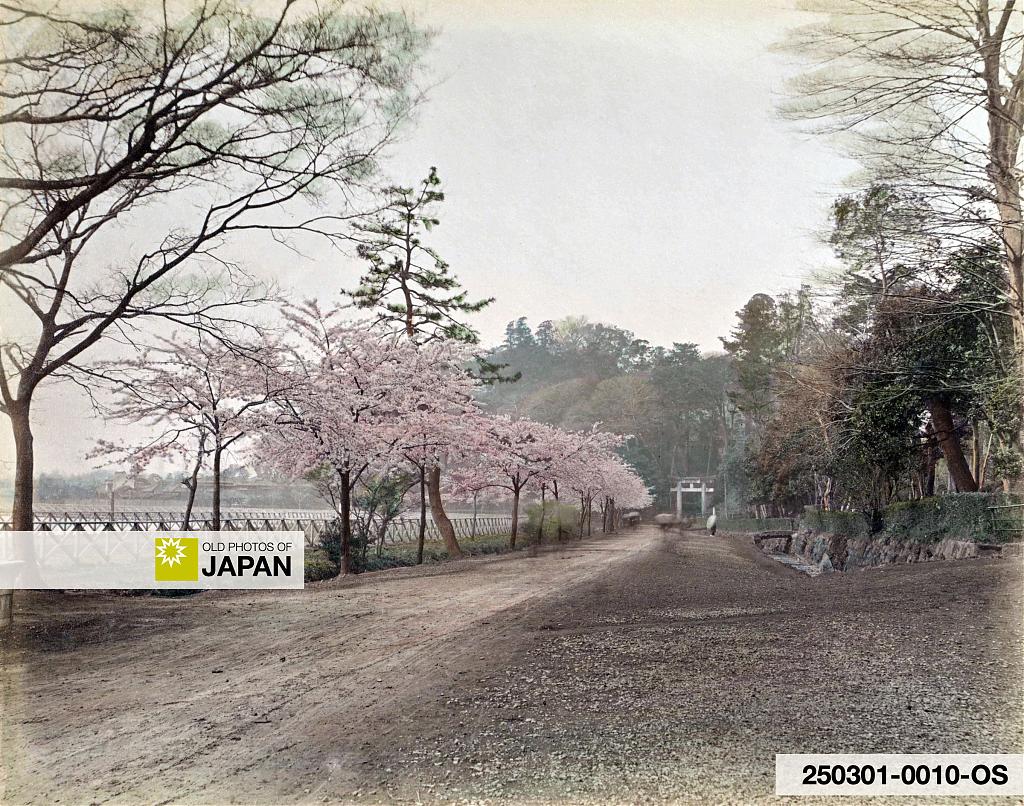
This state of affairs continued for several years. Every spring and autumn, horse races were organized on the idyllic new track, attracting members of the imperial family, councillors, government officials, and foreign envoys, along with large crowds cheering on the horses.
Over time, the grandstand also served as a venue for banquets, exhibitions, and major civic events. It became an integral part of Ueno Park, dominating the view of the pond. Moreover, in 1890 (Meiji 23), the Shinobazu races were held on an even grander scale as part of the Third National Industrial Exhibition.
However, everything changed abruptly in 1893 (Meiji 26).
Continue to Part 3: The fate of Ueno Park’s racetrack.
Three Extremely Rare Images
Last week’s article about the forgotten horse races at Tokyo’s Ueno Park featured three photos of the grandstand. Original prints of this building, particularly those in good condition or hand-colored in the 1800s, are extraordinarily rare. In fact, the Duits Collection may be the only collection to hold all three.
Find out more about the photos of the Shinobazu Grandstand.
Notes
20 小野良平 (1997)『上野公園における公的儀式とその空間形成への影響』ランドスケープ研究 : 日本造園学会会誌 : Journal of the Japanese Institute of Landscape Architecture, 60(5) 1997.03, 409.
The Ministry of Home Affairs was vital in centralizing state power and implementing modernization.
21 Duits, Kjeld (2018). Tokyo 1870s • Windmill at Ueno-Hirokoji. Old Photos of Japan.
22 立川健治 (2008).『文明開化に馬券は舞う : 日本競馬の誕生』世織書房, 13.
23 The Japan Weekly Mail. Vol.34 (January to June 1884) Edition Synapse, 289 (March 29, 1884).
24 立川健治 (2008).『文明開化に馬券は舞う : 日本競馬の誕生』世織書房, 11–12.
「抑も此場たるや池水を環繞し、東は上野山に傍い、西南は市外を帯び限るに一流を以てし、北は広瀾の地に就て観馬台を設け、其馬場の延袤は八八〇間(一マイル換算)、其幅員一二間、あたかも巨大の玉環を得て明鏡の四辺に旅するが如く、其長短広狭は都て競馬の原則たる距離に違はず、蓋し天は一池を造って、以て本邦馬産の為めに此好場を与うるに似たり、況や山水の佳麗地境の優美なる実に東京第一に居るに於てをや。」
25 ibid, 8–9.
26 ibid, 10.
27 Chamberlain, Basil Hall; Mason, W. B. (1896). A Handbook for Travellers in Japan. London: John Murray, 105.
28 Conder, Josiah; Ogawa, K. (1893). Supplement to Landscape Gardening in Japan. Yokohama: Kelly And Walsh, Limited, Plate I.
29 Miki, Teiichi; Nakamura, Toyonosuke; Takahashi, G. (translator) (1887). Pictorial Descriptions of the Famous Places in Tōkyō. 『東京めいしよ図譜/東都花容月影譜』Tokyo: Kyūshundō.
30 Hugh Fraser, Mrs. (1899). A Diplomatist’s Wife in Japan: Letters from Home to Home, Volume 1. London: Hutchinson & Co., 161–163.
Published
Updated
Reader Supported
Old Photos of Japan aims to be your personal museum for Japan's visual heritage and to bring the experiences of everyday life in old Japan to you.
To enhance our understanding of Japanese culture and society I track down, acquire, archive, and research images of everyday life, and give them context.
I share what I have found for free on this site, without ads or selling your data.
Your support helps me to continue doing so, and ensures that this exceptional visual heritage will not be lost and forgotten.
Thank you,
Kjeld Duits
Reference for Citations
Duits, Kjeld (). Tokyo 1880s: The Forgotten Horse Races of Ueno Park (2), OLD PHOTOS of JAPAN. Retrieved on October 15, 2026 (GMT) from https://www.oldphotosjapan.com/photos/992/the-forgotten-horse-races-of-ueno-park-2


Noel
I’ve seen the headline photograph many times before, but I was mostly focused on the island on the Shinobazu Pond, not knowing the image also includes the racetrack. I see that your copy doesn’t have any signatures or serial numbers, but there are ones that do, for example this one .
Also, the last photo in the article comes with two caption options:
1) a copy at Rijksmuseum – as a part of an accordion album of 30 photographs that share similar series number with an inverted (or mirrored) “N”
2) a copy at Nagasaki Database with caption attributted to Kajima Seibei atelier
#000896 ·
Kjeld Duits (Author)
@Noel: Thanks as always for your perceptive and helpful comments. What makes the top image special is that it was shot in summer when the lotus flowers bloom (early July to late August). That was right in between the spring and autumn races, so the racetrack is full of grass, making it quite hard to notice.
The image at Cornell is an eye opener. Cornell inaccurately attributed it to Kimbei. The negative number is however indisputably by Kozaburo Tamamura. Although he first started in 1874, he opened his first Yokohama studio 1883, the year before the races started at Shinobazu. I am going to change the attribution and the dating.
The second photo is a conundrum. I think we need more information before we can confidentially attribute it to Kajima Seibei.
#000897 ·
Noel
Your article inspired me to look through my digital archive and I managed to identify two photos featuring racetrack. They are not revolutionary in comparison to your collection but you might enjoy checking them out.
I also have some shots of Shinobazu Pond’s Bentenjima Island taken from similar angle as in Kimbei’s, but two of them show wooden buildings on both sides of the passage to the island. I was wondering if that would date the image pre- or post-Kimbei shot.
#000901 ·
Kjeld Duits (Author)
@Noel: Thank you, Noel. There are always images that I have never seen before. The “View of Uyeno Tokio” is new to me. The typed caption suggests it is from a Kimbei album, but I can’t see a number on the print and there is no entry in the 1893 Kimbei catalogue that refers to this image.
Good question about the buildings at Bentenjima Island. Are you able to share the two images?
#000902 ·
Noel
I did some digging and found my images online. The first one might have been taken by Usui Shuzaburo. The second one can be found in two versions in the Nagasaki Database – VERSION ONE attributted to Suzuki Shinichi II (marking in the bottom left corner) and VERSION TWO unattributted, but has a marking in the bottom right corner (#81). The description says the photos were taken before Ueno was designated as a park in 1873.
I have also found a third one in the Nagasaki Database that was probably taken before 1868.
#000903 ·
Kjeld Duits (Author)
@Noel: Great finds, Noel. I now understand what buildings you were referring too. I often check the site of the Nagasaki University Library so the last three images were familiar. The image on the Regione Lombardia site was new to me. Thanks for sharing!
#000904 ·