
PART 1 | PART 2
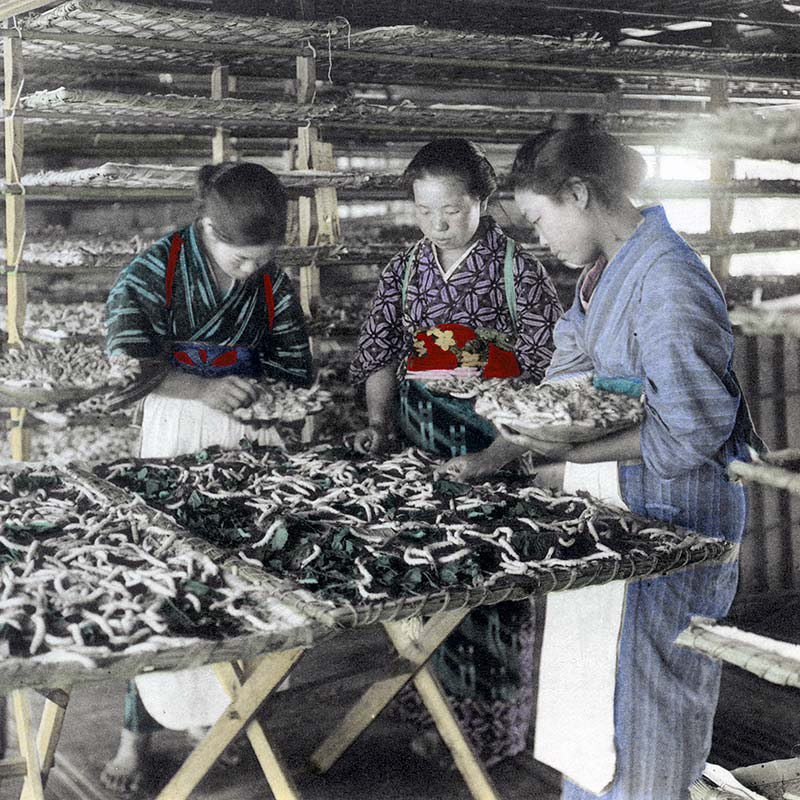
Three women harvesting silk cocoons. From a rare photo book about Japanese silk farmers in the 1920s. This article reproduces the book.
This is Part 2 of a two-part article introducing this book.
This rescue project is funded by readers like you
Old Photos of Japan provides thoroughly researched essays and rare images of daily life in old Japan free of charge and advertising. Most images have been acquired, scanned, and conserved to protect them for future generations.
I rely on readers like you to keep this online museum going.
When this book, The Silk Industry of Japan, was published, silk was one of Japan’s most important industries (see The Quiet Power of Japanese Silk).
The book’s 20 collotype photos have been reproduced with the original English and Japanese captions. The Japanese text was printed from right to left, but is shown here from left to right. However, the characters have not been modernized.
Because the original text includes errors and omissions I have added titles and non-italic explanatory notes for context.
The Silk Industry of Japan
For photos 1 through 10, see “The Silk Industry of Japan” (1).
11. Scaffolding for Cocooning

Making straw layers on which the silkworms are kept while reaching maturity
マブシ折リト稱シ上簇シタル蚕兒ヲ入ル、處即チ蚕兒ノ巢ヲ掛ケル場所ヲ作ル圖ナリ
A farmer is using a wara mabushi ori-ki (藁蔟折機), a machine to fold straw to make mabushi (蔟), bamboo and straw scaffolding on which silkworms can easily spin their cocoons.
12. Placing Silkworms on Mabushi

Spreading the maturing silk worms on the prepared layers
上簇シタル蚕兒ヲ簇ニ入ル、圖(僕トハ「マプシ 」ニテ作リタメルモノナリ)
At the end of the fifth instar, silkworms are placed on the mabushi to start cocooning. They then spin cocoons nonstop for two to three days.
13. Inspecting Cocoons

The silkworms are now forming into cocoons and are being inspected
収繭ヲ驗スルノ岡即チ蠶兒上簇後巢ヲ掛テ繭トナリタル時之ヲ驗スルナリ
A woman is inspecting the cocoons that the silkworms have spun on the mabushi. During cocooning, silkworms wrap themselves in a cocoon made of a single silk filament measuring up to 1,500 meters in length. Within the cocoon the silkworm transforms into a pupa.
14. Harvesting Cocoons

The matured cocoons
収繭
The cocoons are harvested about 5 to 8 days after the silkworms began spinning, when the pupae are fully formed and hard, but before they can emerge as moths. This process is known as shūken (蚕座). Each cocoon is carefully checked for its quality and diseased or incomplete cocoons are removed.
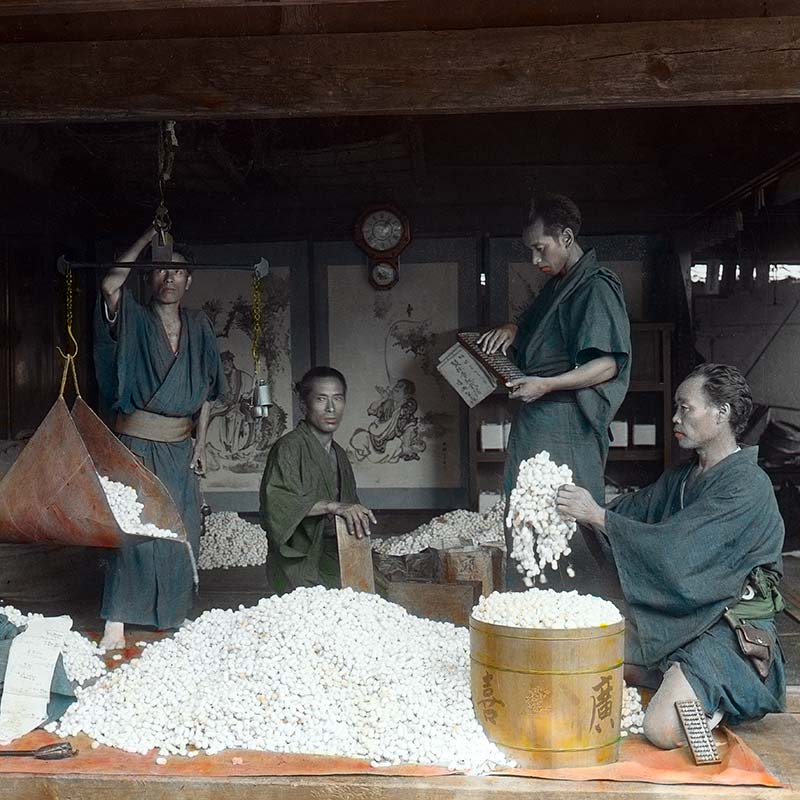
15. Weighing Cocoons

A basket of cocoons ready for reeling
収繭
A silk farmer weighs a basket of cocoons ready for reeling. By the 1920s, the Japanese silk industry had developed a surprisingly wide range of options for silk farmers to sell their cocoons:17
- Selling directly to brokers or agents of filatures at their own house.
- Taking the cocoons to a broker, filature, or auction market.
- As a member of a rearers’ society or guild, which usually dealt directly with a filature.
- Through a co-operative drying society, which dried and sold the cocoons of its members.
16. Seed Moths

Cocoons specially allowed to mature into butterflies, from which the eggs for the next year are taken
収繭ノ中蛋種トスル分ハ之ヲ種繭ト稱シテ生繭ノ儘ニナシ置キ凡ソ二週間ヲ經過後蛾ト變ヅ繭ヲ喰ヒ破リテ出ヅ
Some of the harvested cocoons were selected for breeding. These seed cocoons, known as tane mayu (種繭), were left unprocessed.
Generally, about two weeks after the silkworm started spinning the cocoon, it emerges as a moth. It cannot fly and does not eat; after mating and depositing eggs, it dies.
17. Seeding Egg Cards

Butterflies depositing silkworms eggs on specially prepared laying paper
蛾ノ交尾後種紙ニ產卵スル圖
After mating, moths were placed on egg cards, also known as seed paper. Here they laid their eggs. Each egg card held the eggs of 28 moths.
To make the egg cards, a box frame with 28 compartments was placed over a card, and a moth was set in each compartment to lay its eggs. The compartments are clearly visible on this photo, on which 20 egg cards are being seeded.
Instead of a box, individual copper and tin cones were also placed on the paper.
18. Drying Cocoons

Drying of Cocoons
繭ノ乾燥
Two workers are placing cocoons into a drying chamber. Cocoons are dried to kill the pupa, so it will not break the cocoon’s continuous silk thread and to remove moisture that could lead to rot or mold during long-term storage. The process hardens the silk shell and protects its quality.
Traditionally, cocoons were dried in the sun. But this exposes the cocoons to rats, mice, and insects. Sun drying also affects the quality of silk. Therefore, silk farmers started drying cocoons in special drying chambers like the one in this photo, either by circulation of the air or by heat.
The killing of the pupa, known as stifling, requires precise timing. Imperial Tokyo Sericultural Institute director Honda described this as follows:18
Stifling must be done immediately after the silkworm has spun the cocoon, that is, within seven days after the mounting in the case of the spring breed and five days in that of the autumn breed. If stifling is too early, it may kill the silkworm before he has finished spinning or even if it has already changed into a pupa by that time, its skin may be so delicate that it may easily break open during the treatment and spoil the inside of the cocoon. The damage from this cause is the greatest when the worms are just changing into pupae.
19. Reeling the Silk

The cocoons are now placed in hot water and the silk thread is reeled off
蛾トビザル繭ヲ熱湯ニスレ糸ヲ取ル圖
The cocoons are placed in hot water to soften the sericin, a natural gum that holds the silk fibers together. This allows the silk threads to be reeled.
When British travel writer Isabella Bird visited Yamagata in 1878, much reeling was still done at home, so she saw the above scene everywhere:19
In almost every house front that I pass women are engaged in reeling silk. In this process the cocoons are kept in hot water in a copper basin, to the edge of which a ring of horsehair or a hook of very fine wire is attached. For the finest silk, the threads of five or six cocoons are lifted up and passed through the ring to the reel with the first and second fingers of the left hand, the right hand meanwhile turning the handle of the reel. Much expertness is required. The water used must be very pure, and is always filtered before it is used, or the silk loses its natural gloss.
20. Modern Reeling

Present day methods of reeling silk from cocoons
製糸場ノ圖現今行ハル、器械ニヨリテ製糸スル處ナリ
A long line of young female workers operate powered machinery to reel silk in a modern silk factory.
Although Japan’s first modern silk factories appeared as early as the 1870s, most workplaces remained small. Even in 1908 (Meiji 41), nearly 99% of the country’s more than 392,000 workshops and factories operated fewer than ten cocoon-boiling basins, most of them women working from home. Not a single facility exceeded 300 basins, the threshold experts regarded as necessary to achieve economies of scale.
The 1920s brought drastic change. By 1927 (Showa 2), the number of workshops with fewer than ten basins had dropped to 80,000, down from almost 387,000 in 1908. Large-scale operations expanded rapidly: 218 factories now ran more than 300 basins, with eight of them operating over 1,000.20
| Year | ~10 | ~50 | ~100 | ~300 | ~500 | ~1,000 | 1,000~ |
|---|---|---|---|---|---|---|---|
| 1908 | 386,996 | 3,968 | 645 | 405 | 0 | 0 | 0 |
| 1917 | 265,460 | 3,968 | 1,026 | 796 | 0 | 0 | 0 |
| 1922 | 204,311 | 1,696 | 854 | 683 | 114 | 71 | 9 |
| 1927 | 80,034 | 1,734 | 875 | 707 | 128 | 82 | 8 |
In 1927, the silk industry employed some 496,000 workers, 93% of whom were women, most between the ages of 15 and 20. Life was hard for these factory girls. They typically worked about 11 hours a day, six or seven days a week. About 80% of them lived in company dormitories that they could leave only with permission. Opportunities for leisure or recreation were scarce.21
American zoologist and archaeologist Edward Sylvester Morse, whom we first met in the previous article, saw factory-style reeling at the First National Industrial Exposition (第1回内国勧業博覧会), held in 1877 in Tokyo’s Ueno Park. In his brief description he expressed his surprise about the work:22
The process of reeling was very interesting. I had supposed a single thread was caught from the cocoons and unwound. The cocoons, to the number of thirty or forty, are put into a shallow pan of hot water, and with a brush, which you will see at the corner of the table, the cocoons are soused up and down in the water until the fibres get loose and adhere to the brush; then all the fibres that are caught are reeled off together, and as one after the other breaks it is caught up again. A steam pipe keeps the water hot and above is a shaft containing the reel.
Bird visited one of the early silk factories a year after Morse’s visit. She noted that the managers and engineers all wore European clothes, and described a “light, lofty, well-ventilated building” and “clean, well-dressed girls.”23
It is a light, lofty, well-ventilated building, running 50 spindles (shortly to be increased to 100), worked by as many clean, well-dressed girls. Those who are learning get little besides their food, the skilled hands earn 5s. a week and food. The machinery is run by a steam-engine of twenty horse-power, made and worked by Japanese. In front of the spindles is a row of tables at which the girls are seated, on high, cushioned stools, each one with a brass pan full of water kept at a given temperature, which contains the cocoons. They lift the ends of the silk with small brushes made of twigs, and pass them through glass rings to the spindles. The working day is eleven hours.
Silk Cats
An important aspect of silk farming is missing from these photos. Since the Edo Period (1603–1868), farmers were encouraged to keep cats to protect cocoons and larvae from rats. Unfortunately, so far I have been unable to find any vintage photo of silk farmers that includes a cat. There are, however, ukiyoe woodblock prints of silk farming that depict these furry silkworm protectors.


Cats were so vital to silk farmers that they worshipped them as guardians of silkworm harvests. Shrines and temples venerating cats remain to this day. Often, a hanging scroll with a picture of a cat was displayed in the silkworm-rearing room as a charm to ward off rats.
Gunma Prefecture’s Nitta Iwamatsu clan (新田岩松氏) was especially famous for producing such pictures. They painted cats for four generations and are known as the “Lords of Cat Paintings” (猫絵の殿様, Neko-e no tonosama).24

In the late Edo Period (1603–1868), cats in some areas of Ōshū (奥州), today’s Tōhoku region, were considered so valuable that they cost five times as much as a horse.25 You might be familiar with Tashirojima in Miyagi Prefecture, arguably Japan’s best known cat island. Cats used to be kept here to protect silkworm farms, once an important local industry.

Postcards
Ten of the photos in The Silk Industry of Japan were published as a set of hand colored postcards. I have been able to acquire this set for the Duits Collection as well. The postcards help date the undated book to the 1920s.

Today, Japan’s silk industry is a mere shadow of what it used to be. We will look at this transformation in the next article.
Sericulture Vocabulary
A brief list of Japanese vocabulary related to sericulture. Note that the character for silkworm (蚕, kaiko) is composed of heaven (天) and insect (虫).
| Term | Japanese | Meaning |
|---|---|---|
| Chisan | 稚蚕 | Silkworm larvae in the first to third instars. |
| Domuro | 土室 | Small rooms for silkworm rearing equipped with ventilation and a charcoal fire for regulating heat and humidity. |
| Haki oroshi | 掃き下ろし | Sweeping the hatched larvae onto the tray with a feather duster and giving them their first mulberry leaves. |
| Hakitate | 掃き立て | The process of moving newly hatched silkworms to the sanza. By extension, it is also the first day of silkworm rearing. |
| Jōzoku | 上蔟 | Collecting mature silkworms and transferring them to mabushi to spin cocoons. |
| Jukusan | 熟蚕 | Matured silkworm. |
| Kaiko | 蚕 | Silkworm. |
| Kiito | 生糸 | Raw silk. |
| Kyūsō | 給桑 | Feeding mulberry leaves. |
| Mabushi | 蔟 | Bamboo and straw scaffolding on which silkworms spin their cocoons. |
| Mayu | 繭 | Cocoon. |
| Sanshi | 蚕紙 | Egg cards. |
| Sanshitsu | 蚕室 | The room where silkworms are raised. |
| Sanza | 蚕座 | The tray on which silkworms are raised. |
| Shūken | 収繭 | The process of harvesting cocoons. |
| Shūmin | 就眠 | The state of falling asleep and not eating mulberry leaves. |
| Tomekuwa | 止め桑 | The last feeding before going to sleep. |
| Yōsan | 養蚕 | Sericulture. |
Related Articles
Notes
17 Ghosh, Charu Chandra (1933). The Silk Industry of Japan with Notes on Observations in the United States of America, England, France and Italy. Delhi: The Imperial Council of Agricultural Research, Manager of Publications, 17–18.
18 Honda, Iwajirō (1909). The Silk Industry of Japan. Tokyo: The Imperial Tokyo Sericultural Institute, 149–151.
19 Bird, Isabella L. (1881). Unbeaten Tracks in Japan: an Account of Travels on Horseback in the Interior, Including Visits to the Aborigines of Yezo and the Shrine of Nikkō. Vol. 1. New York: G. P. Putnam’s Sons, 265.
20 Ghosh, Charu Chandra (1933). The Silk Industry of Japan with Notes on Observations in the United States of America, England, France and Italy. Delhi: The Imperial Council of Agricultural Research, Manager of Publications, 23.
21 ibid, 24.
For details about the lives of women working in Japan’s early textile mills, read: Tsurumi, E. Patricia (1990). Factory Girls: Women in the Thread Mills of Meiji Japan. Princeton: Princeton University Press.
22 Morse, Edward Sylvester (1917). Japan Day by Day: 1877, 1878-79, 1882-83. Volume I. Boston and New York: Houghton Mifflin Company, 250.
23 Bird, Isabella L. (1881). Unbeaten Tracks in Japan: an Account of Travels on Horseback in the Interior, Including Visits to the Aborigines of Yezo and the Shrine of Nikkō. Vol. 1. New York: G. P. Putnam’s Sons, 277.
24 板橋春夫 (2023).「新田猫の生成と展開』日本民俗学 314巻, 37-68.
25 松浦静山; 中村幸彦; 中野三敏 (2014).『甲子夜話 続篇 2:巻二十〔二三〕』 平凡社.
「晁又曰。獣毛に紫色は絶て無きものなるが、奥州の猫には往々紫色あり。その紫は藤花の紫色の如し。奥州は養蚕第一の国にて、鼠の蚕にかゝる防(ふせぎ)とて、猫を殊に選ぶことなり。上品の所にては、猫の価金五両位にて、馬の価は一両位なり。土地によりて物価の低昻かく迄なるも咲(わらふ)べし。山猫の紫色なるは、若や人家畜猫の老て山に入り物にやと云ふ。予先年旅行せしとき、備前の神崎かにて猫の圃中を歩するを見たり。大さ犬ほどありて尾は長く三毛なり。傍人に猫よ奇(くし)きものと云中に藪に入りたり。猫も大なる者まゝあり。」
Published
Reader Supported
Old Photos of Japan aims to be your personal museum for Japan's visual heritage and to bring the experiences of everyday life in old Japan to you.
To enhance our understanding of Japanese culture and society I track down, acquire, archive, and research images of everyday life, and give them context.
I share what I have found for free on this site, without ads or selling your data.
Your support helps me to continue doing so, and ensures that this exceptional visual heritage will not be lost and forgotten.
Thank you,
Kjeld Duits
Reference for Citations
Duits, Kjeld (). Inside 1920s: "The Silk Industry of Japan" (2), OLD PHOTOS of JAPAN. Retrieved on October 18, 2026 (GMT) from https://www.oldphotosjapan.com/photos/987/the-silk-industry-of-japan-2-1920s


There are currently no comments on this article.