
PART 1 | PART 2
Selecting silkworms for spinning cocoons. From a rare photo book about Japanese silk farmers in the 1920s. This article reproduces the book.
This is Part 1 of a two-part article introducing this book.
This rescue project is funded by readers like you
Old Photos of Japan provides thoroughly researched essays and rare images of daily life in old Japan free of charge and advertising. Most images have been acquired, scanned, and conserved to protect them for future generations.
I rely on readers like you to keep this online museum going.
When this book, The Silk Industry of Japan, was published, silk was one of Japan’s most important industries (see The Quiet Power of Japanese Silk). Japan’s raw silk industry at this time was divided into distinct sectors:1
- Government-supervised egg production.
- Mulberry cultivation.
- Cocoon production, mainly at small farms.
- Reeling of cocoons into raw silk, increasingly at mechanized factories.
- Trading firms specializing in raw silk.
In addition, there were textile manufacturers producing silk cloth.
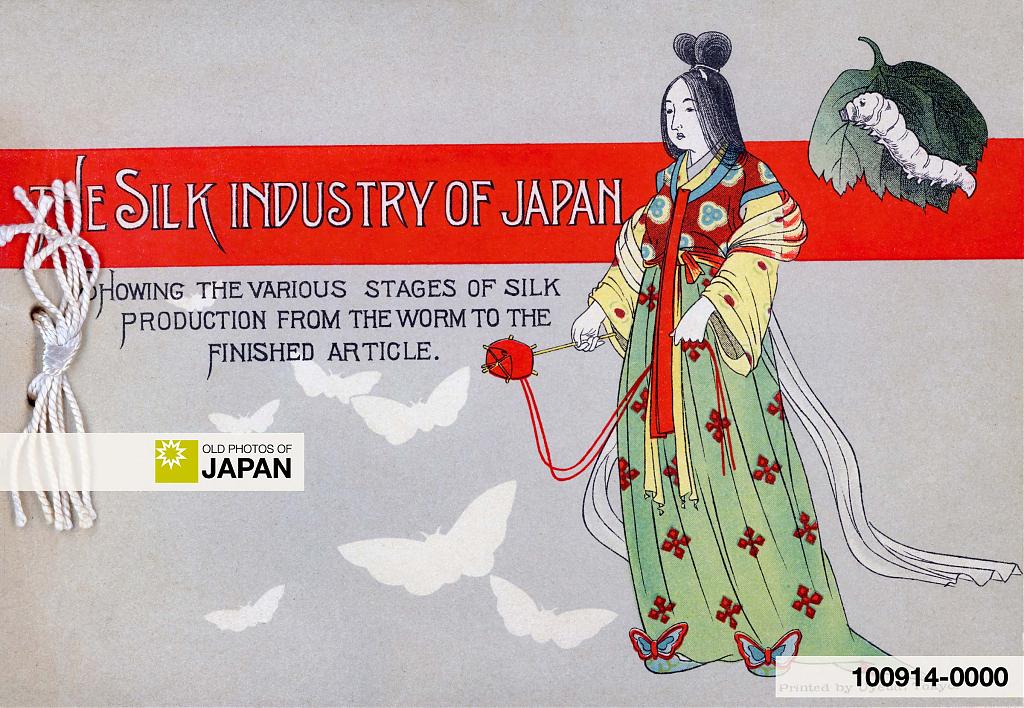
The Silk Industry of Japan focuses solely on #3, the farmers raising silkworms for cocoons. Little is known about this book. It was printed by a company introduced on the cover as Uyeda (Ueda) in Tokyo. However, the author, photographer, publisher’s address, and publication date are unknown.
It appears to be relatively rare. There is a copy in the collections of Amsterdam’s Rijksmuseum, and it occasionally pops up at auctions and used bookstores. However, Japan’s influential National Diet Library does not list the book and neither do major libraries like the Library of Congress and the British Library.
Silkworms
Before looking at the photos, some background about the silkworm’s life cycle. This lasts a year, but for much of that time the eggs are dormant.
Active silkworms go through five developmental stages, known as instars (齢, rei). Between each instar, silkworms stop feeding and go through a molting period in which they shed their skin. These molts last about 18 to 24 hours. At the end of the fifth instar, the silkworms spin cocoons nonstop for two to three days. It takes about a month for a silkworm to grow large enough to spin a cocoon.
The great majority of the cocoons are used for producing silk. But some cocoons are kept for seeding the next generation. After about fifteen days, the silkworms emerge from these cocoons as moths. They mate, deposit their eggs, and die. The following clip shows the speeded up life cycle of a silkworm in just a minute:
The Silk Industry of Japan
The book’s 20 collotype photos have been reproduced with the original English and Japanese captions. The Japanese text was printed from right to left, but is shown here from left to right. However, the characters have not been modernized.
Because the original text includes errors and omissions I have added titles and non-italic explanatory notes for context.
1. Selling Egg Cards

Transaction of Silkworm-egg Card
蚕卵紙賣買の圖
Silk producers and merchants examine silkworm egg cards (蚕紙, sanshi) — sheets of paper with silkworm eggs — during a business transaction. In 1928 (Showa 3), nearly 19 million of these egg cards were used.
The silkworm egg trade employed more than 40,000 people. To prevent disease and maintain the highest quality of silk, this was a tightly controlled business. Eggs were produced by government experiment stations and by about 8,000 licensed private producers working under strict government oversight. Female moths and egg cards were required to undergo official inspection, and only those bearing a government stamp of approval could be sold. Silkworm farmers were prohibited by law to produce eggs themselves.2
For a time, the silkworm egg cards themselves were a key export. In the 1860s, Japan shipped them to France to help revive its silk industry, then crippled by a silkworm disease. The trade faded in the 1880s, after the outbreak was overcome.
Famed American zoologist and archaeologist Edward Sylvester Morse (1838-1925) encountered this trade in 1877 (Meiji 10), when he spent a night in Nowata, a poor village in Tochigi Prefecture:3
From the ceiling hanging from long poles were hundreds of cards of silkworm eggs ready for exportation to France. These cards of pasteboard were fourteen inches long and nine inches wide, and, we understood, they were worth five dollars a card. Good cards contained from twenty-four to twenty-six thousand eggs. The cards were hung back to back, each card having the owner’s name on the back. A company in Yokohama controls the price of eggs. The company buys up all there are in the country, and one year, in order to keep the price up, actually destroyed all above a certain number.
2. Newly Hatched Silkworm Larvae

The Silkworms-eggs, just hatched
每年四月下句種紙ヨリ蠶卵ノ蜉化シタル時之ヲ掃キ下スノ圖
Removing newly hatched silkworm larvae from the egg cards with a feather duster. The Japanese text dates this to late April.
During the Meiji Period, new cold storage methods for eggs made it possible to raise silkworms twice a year instead of just once: first between April and June and again between August and October.4
By the late 1920s, the two harvests were about the same size, but spring remained the main season because of its better quality silk. The number of crops depended on how many mulberry leaves were available as overharvesting could seriously harm the trees. The government, therefore, encouraged separate mulberry fields for the spring and fall crops.5
Some farmers produced three crops per year, but this was rare.
3. Picking Mulberry Leaves

Picking of mulberry leaves No. 1
桑摘
Mulberry formed the foundation of sericulture, representing roughly half of total production costs. For centuries, it was cultivated in small plots among crop fields or beside houses. However, during the Meiji Period, dedicated mulberry plantations began to appear.
By the 1920s, the majority of mulberry plants were grown as low bushes, with the remainder cultivated as trees.
Around this period, some 199,000 nurserymen supplied mulberry seedlings, grafts, and layerings. Like silk egg producers, they operated under government licenses and were regulated by special laws. Their products had to pass inspections to ensure proper size and freedom from disease or insect infestation.6
A fun bit of mulberry trivia: In 1889 (Meiji 22), Kyoto entrepreneur Fusajirō Yamauchi (山内房治郎, 1859–1940) founded a company to produce beautiful hanafuda playing cards made from mulberry bark. He named it Nintendo. The company still makes hanafuda, but is now better known for its video games.
4. Picking Mulberry Leaves

Picking of mulberry leaves No. 2
桑モギ
In this image, complete branches have been harvested, and the workers are removing the leaves. As usual, most of the workers are women.
In some areas, farmers placed complete branches on the silkworm trays during the last two stages of rearing. This method minimizes leaf wastage and reduces labor, while the quality of the leaves lasts longer.
5. Cutting Mulberry Leaves

Cutting mulberry leaves to feed the Silkworms
養蠶ニ用フル桑葉細切圖
In 1909 (Meiji 42), Iwajirō Honda (本多岩次郎, 1866–1936), director of the Imperial Tokyo Sericultural Institute, published The Silk Industry of Japan, an important and comprehensive study of the nation’s silk production. In it, he emphasized properly cutting mulberry leaves:7
The Chopping of Mulberry Leaves. Mulberry leaves are chopped so that they may be evenly distributed among the silkworms in the tray. Chopped mulberry leaves are used for the silkworms from the first age to the beginning of the fifth age. They must be cut square, their sizes corresponding to the age of the silkworm. Irregularly chopped leaves will be quite contrary to the object of chopping and end in the waste of labour.
Although Honda recommended cutting mulberry leaves for all five instars, in practice this seems to have been done mainly for young silkworms. Photographs show that older silkworms were fed whole leaves or even entire branches.
British travel writer Isabella Bird (1831-1904) observed traditional silk farming while traveling through Yamagata Prefecture in 1878 (Meiji 11). Intriguingly, she noted that the leaves for newly hatched silkworms were mixed with millet bran:8
The mulberry leaves with which they are fed are minced very fine and sifted, so as to get rid of leaf fibre, and are then mixed with millet bran.
6. Shelves and Trays

Having fed for about 20 days after the first sleep, the silkworms take their second sleep
蛋兒發生後十四日間ニテー眠ス之レヲ第一令ト名クー晝夜半位ニシテ再ビ覺醒シ桑葉ヲ喰ヒ又一週間位ヲ經テニ眠ス斯クシテ前後四回眠ルナリ圖八第二令ヲ示スモノナリ
Silkworms were reared indoors on trays known as sanpaku (蚕箔). In this scene, the woman holds one of these silkworm trays. They were made of bamboo and straw and arranged on the shelves of racks called sanka (蚕架).
Most farms placed a fire in a pit, or a heater, in the middle of the room to regulate the temperature and humidity.9 Some farmers built special houses with a yagura extension on the roof for better air circulation. In these houses, generally no heat was used and the silkworms were reared on the second floor.10

Incidentally, the author and translator of The Silk Industry of Japan seem to have lost their way with the photo of the woman holding the tray. In the English text feeding lasts for 20 days after the first sleep, while the Japanese is as follows:
About fourteen days after hatching, the silkworms fall into their first sleep, which is called the first instar. After about half a day and night, they awaken again and begin eating mulberry leaves. After about another week, they fall asleep a second time. In this way, they sleep a total of four times. The illustration shows the second instar.
Both 14 and 20 days are excessively long. Generally, the first three instars do not last longer than four days each.
7. Cleaning the Trays

The silkworms taking their third sleep
蚕兒第三令後ノ圖
This photo shows workers cleaning the silkworm trays. Before feeding began, a cotton net called a sanmō (蚕網) was placed over the silkworms, and mulberry leaves were spread on top. The silkworms crawled up through the mesh to reach the leaves.
When the net was lifted, the silkworms were easily separated from their droppings and any uneaten leaves. The net holding the silkworms was then moved to a fresh tray, and the soiled tray was cleaned.
The nets were soaked in persimmon tannin to increase strength and provide antiseptic qualities. Nets with progressively larger mesh sizes were used as the silkworms grew. They were also known as kaiko shiritori-mō (蚕尻取り網).11
8. Feeding Mulberry Leaves

Feeding the silkworms with mulberry leaves
蚕兒ノ生育ニ伴ヒ桑葉ヲ與フル圖
Feeding silkworms involved far more than simply scattering leaves on top of them. Depending on their stage of development, the room’s temperature and humidity, and their appetite, they were typically fed four to eight times a day. Young silkworms were fed most often as they ate at more frequent intervals and their tender leaves dried out quickly.
The silkworms’ inconsistent appetite made the work demanding. After each molt, the silkworms’ appetite decreased for two or three days before increasing again as the next molting period approached. Imperial Tokyo Sericultural Institute director Honda emphasized carefully matching feedings to this fluctuating appetite:12
After all, the secret of feeding is to make the silkworm eat as much as it pleases, and leave as little leaf as possible unconsumed. If much food is left unconsumed in the tray, it is not only uneconomical, but makes an accumulation of litter, which is very objectionable for the health of silkworms. So in feeding silkworms, a delicate and sympathetic discretion must be exercised as to the quantity of food and the appetite of the silkworms as well as to the cleanliness of the tray.
Keeping the trays clean became increasingly challenging during the fifth stage, when the silkworms consumed 80% of their total food intake and consequently produced far more waste. At the same time, the damp weather typical of June made the rooms unpleasant. Honda advised that the litter be “cleared off once or twice every day.”13
British travel writer Bird noted that the work demanded such constant attention and care that the women, who did most of the silkworm rearing, had little time for anything else:14
Food is usually given five times a day, but in hot weather as many as eight times, and as the worms grow bigger their food grows coarser, till after the fourth sleep the leaves are given whole. The quantity is measured with great nicety, as the worms must neither be starved nor gorged. Great cleanliness is necessary, and an equable temperature, or disease arises; and the watching by day and night is so incessant, that, during the season, the women can do little else.
Women worked so hard that they barely slept. It was said that “once the silkworms start, you don’t untie your obi” (蚕が始まると帯を解かない). Elementary schools in sericulture regions took a break during the harvesting season so children could lend a hand.15
It must have brought the women some comfort that nearly matured silkworms munching on leaves sound just like a soft rain shower. The room was filled with a constant, soothing murmur.
9. Selecting Matured Silkworms

After taking their fourth sleep, the worms are now matured sufficiently to permit of selection
蚕兒第四令後上簇ス即チ身體透明ニナリ絹糸ヲ腹中ニ生ス此期ニ於テハ最早桑葉ヲ喰スルヿナシ圖ハ熟シタル蚕兒ヲ選擇スル所ナリ
At the end of the fifth instar, silkworms weigh 10,000 times their hatch weight. They are now considered matured. When their bodies have become semi-transparent, and they have evacuated all waste from their body, they are selected for cocooning, as shown in the above scene. Honda described this as follows:16
When the silkworm has attained its full-growth in the fifth age, its appetite fails all of a sudden and its body assumes an amber color and it throws out a fine thread from its mouth, restlessly moving about in search of a place fit for spinning a cocoon. A silkworm in this state is called matured.
10. Silkworms before Cocooning

Silkworms before matures
上簇前の蚕
During the last two instars, the silkworms change dramatically. After their third molt, they are significantly larger and more mobile, while the marks on the body are clearer. Most growth occurs after the fourth molt, during the fifth and final instar. This photo shows the silkworms at the end of the fifth instar.
The Japanese text reads, “Silkworms before Jōzoku.” Jōzoku (上蔟) is the process of collecting mature silkworms and transferring them to the scaffolding beds where they will spin their cocoons.
Continue to Part 2 of “The Silk Industry of Japan.”
Related Articles
Notes
The book measures 21.5 by 14.8 centimeters.
1 Ghosh, Charu Chandra (1933). The Silk Industry of Japan with Notes on Observations in the United States of America, England, France and Italy. Delhi: The Imperial Council of Agricultural Research, Manager of Publications, 4.
2 ibid, 4, 14.
3 Morse, Edward Sylvester (1917). Japan Day by Day: 1877, 1878-79, 1882-83. Volume I. Boston and New York: Houghton Mifflin Company, 109–110.
4 ibid, 4.
5 ibid, 16–17.
6 ibid, 11–14. Roughly 69% of mulberry plants were grown as low bushes.
7 Honda, Iwajirō (1909). The Silk Industry of Japan. Tokyo: The Imperial Tokyo Sericultural Institute, 104.
8 Bird, Isabella L. (1881). Unbeaten Tracks in Japan: an Account of Travels on Horseback in the Interior, Including Visits to the Aborigines of Yezo and the Shrine of Nikkō. Vol. 1. New York: G. P. Putnam’s Sons, 264.
9 Ghosh, Charu Chandra (1933). The Silk Industry of Japan with Notes on Observations in the United States of America, England, France and Italy. Delhi: The Imperial Council of Agricultural Research, Manager of Publications, 15.
10 Known as takamado no ie (高窓の家, houses with high windows), some of these farms remain in Kodaira in Honjo City, Saitama Prefecture (埼玉県本庄市児玉町小平), where the area has been named Takamado-no-Sato (高窓の里).
11 『明治期の農林水産業発展の歩み・蚕糸業・養蚕』農林水産省. Retrieved on 2025-11-21.
12 Honda, Iwajirō (1909). The Silk Industry of Japan. Tokyo: The Imperial Tokyo Sericultural Institute, 102–103.
13 ibid, 108.
14 Bird, Isabella L. (1881). Unbeaten Tracks in Japan: an Account of Travels on Horseback in the Interior, Including Visits to the Aborigines of Yezo and the Shrine of Nikkō. Vol. 1. New York: G. P. Putnam’s Sons, 265.
15 板橋春夫 (2023).『新田猫の生成と展開』日本民俗学, 314巻, 37-68.
16 Honda, Iwajirō (1909). The Silk Industry of Japan. Tokyo: The Imperial Tokyo Sericultural Institute, 113.
Published
Updated
Reader Supported
Old Photos of Japan aims to be your personal museum for Japan's visual heritage and to bring the experiences of everyday life in old Japan to you.
To enhance our understanding of Japanese culture and society I track down, acquire, archive, and research images of everyday life, and give them context.
I share what I have found for free on this site, without ads or selling your data.
Your support helps me to continue doing so, and ensures that this exceptional visual heritage will not be lost and forgotten.
Thank you,
Kjeld Duits
Reference for Citations
Duits, Kjeld (). Inside 1920s: "The Silk Industry of Japan" (1), OLD PHOTOS of JAPAN. Retrieved on October 10, 2026 (GMT) from https://www.oldphotosjapan.com/photos/985/the-silk-industry-of-japan-1920s


There are currently no comments on this article.