
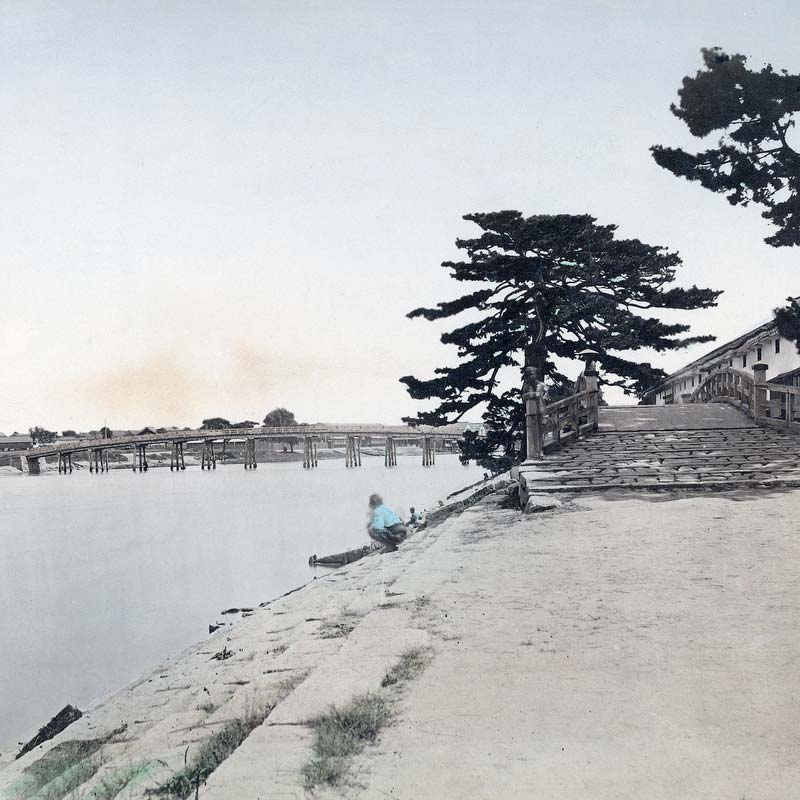
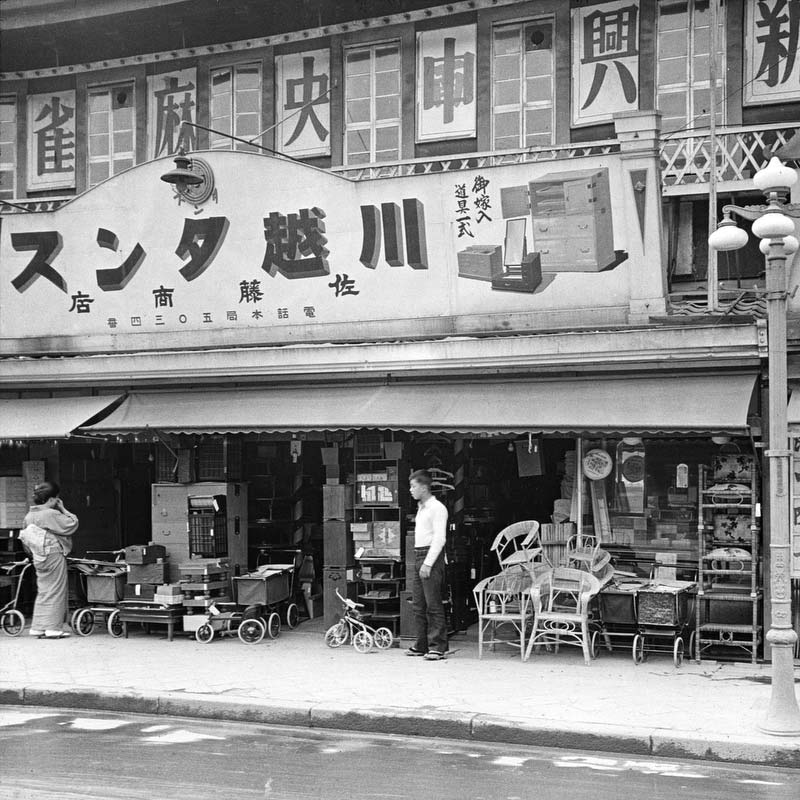
The famous Tomitake-tei theater (富竹亭, Tomitake Hall) on Bashamichi-dori, Yokohama, Kanagawa Prefecture, a stone’s throw from Yoshidabashi Bridge.
The theater, which was active through 1912 (Taisho 1), was owned by Takejiro Takeuchi (竹内竹次郎), who ran three other yose theaters in Yokohama.
Tomitake-tei opened in December 1878 (Meiji 11). One of the theater’s first performers included the now largely forgotten Australian born rakugo story teller and kabuki actor Henry James Black (1858-1923).

Black performed as Kairakutei Black (快楽亭ブラック), but was also known as Ishii Black (石井貎刺屈). His father was John Reddie Black (1826-1880), publisher of several newspapers in Japan, among which The Far East and the Japan Gazette.
During the 1880s and 1890s, rakugo was a catalyst in bringing modernity to the Japanese masses, and Black did much to disperse concepts of modernization.
However, with modernization becoming synonymous with Westernization, Black also warned1 that Japan might loose the unique facets of its culture. As a sample he gave the reforms then occurring in Japanese theater:
Theatre forms in my country England, and in Japan, are fairly different. Above all, there are gentlemen such as Fukuchi Gen’ichirô doing their utmost to reform the theatre. One of the issues is whether it is better to reform by adopting the Western approach, or whether the Japanese theatre is better reformed while retaining its uniqueness entirely.
Perhaps Japanese theater was the last thing that Black needed to worry about. Although much Japanese culture has been lost forever, most modern audiences will undoubtedly say that at least Japanese theater has managed to maintain its uniqueness.
Notes
1 McArthur, Ian Douglas (2002). Mediating Modernity — Henry Black and narrated hybridity in Meiji Japan (pdf), 219.
2 Fukuchi Genichiro (1841–1906) was a Japanese critic and author.
Published
Updated
Reader Supported
Old Photos of Japan aims to be your personal museum for Japan's visual heritage and to bring the experiences of everyday life in old Japan to you.
To enhance our understanding of Japanese culture and society I track down, acquire, archive, and research images of everyday life, and give them context.
I share what I have found for free on this site, without ads or selling your data.
Your support helps me to continue doing so, and ensures that this exceptional visual heritage will not be lost and forgotten.
Thank you,
Kjeld Duits
Reference for Citations
Duits, Kjeld (). Yokohama 1900s: Tomitake Theater, OLD PHOTOS of JAPAN. Retrieved on October 7, 2026 (GMT) from https://www.oldphotosjapan.com/photos/829/tomitake-theater

NyNy
A lovely picture! The theater is amazing.
#000508 ·