
Employees stand between jinrikisha (rickshaws) parked in front of impressive brothels in Osaka’s Matsushima red light light district.
Matsushima was created in 1868 (Meiji 1), nearby Osaka’s foreign settlement of Kawaguchi. The brothel district was established the following year.
Just a few years later, in 1872 (Meiji 5), Osaka Prefectural government started construction on a new Prefecture building, designed by the English architect Walters, on nearby Enokojima. This building was finished in July 1874 (Meiji 7) and used until November 1926 (Taisho 15). The closely located foreign enclave, the lively red light disctrict and the Western style Prefecture building, briefly shared with Osaka City government, must have made this corner of Osaka quite an interesting place to visit.
As the area was newly developed, it required a new name. The name Matsushima was derived from two of the villages that were merged to create the red light district: Matsugabana (松ヶ鼻) and Terashima (寺島).
At Matsushima’s highest point of popularity in 1921 (Taisho 10), some 4,000 women worked here in 275 multistoried buildings (楼閣) with a main street of some 12 meters wide by 360 meters long.
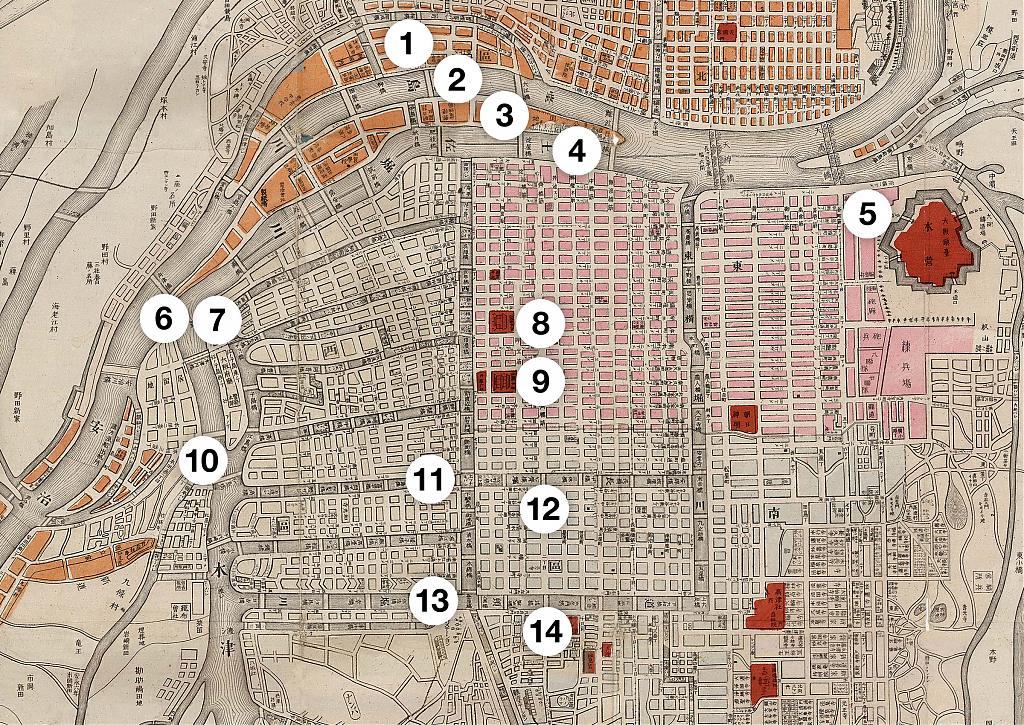
Over the years, Matsushima managed to overcome a lot of adversity: it was partly destroyed by fire in 1885 (Meiji 18), most foreigners living in the Kawaguchi foreign settlement had moved to Kobe by 1899 (Meiji 32), and in 1926 (Taisho 15) it was the scene of a spectacular money scandal involving several respected Osaka politicians.
The worst came in 1945 (Showa 20) when the area was completely destroyed during fire-bombings by US planes. After the war, the former red light district was turned into Matsushima Park and a new red light district was created to the west of the park. It managed a fairly successful comeback, although it never became as big as it used to be.
After the Anti-Prostitution Law (売春防止法) was promulgated in 1958 (Showa 33), the brothels organized themselves as the Matsushima Ryori Kumiai (Association of Matsushima Cuisine) and managed to continue their prostitution business under this misleading monicker.
The area is now one of nine Kansai districts where prostitution is still openly practiced, another one being Tobita.
Published
Updated
Reader Supported
Old Photos of Japan aims to be your personal museum for Japan's visual heritage and to bring the experiences of everyday life in old Japan to you.
To enhance our understanding of Japanese culture and society I track down, acquire, archive, and research images of everyday life, and give them context.
I share what I have found for free on this site, without ads or selling your data.
Your support helps me to continue doing so, and ensures that this exceptional visual heritage will not be lost and forgotten.
Thank you,
Kjeld Duits
Reference for Citations
Duits, Kjeld (). Osaka 1880s: Matsushima Brothels, OLD PHOTOS of JAPAN. Retrieved on October 13, 2026 (GMT) from https://www.oldphotosjapan.com/photos/122/matsushima-red-light-district


Noel
As I was looking for some information on Dotonbori I’ve stumbled across this amazing website researching Osaka’s urban history .
I hope it’ll add to your research as well :)
#000740 ·
Kjeld (Author)
@Noel: Thank you for sharing. Yes, that is a great site isn’t it!
I found it very helpful for a study I wasn commissioned to do by the Netherlands Embassy in Japan last year.
#000741 ·